


Executive Summary
The following entities updated their queue data this period: MISO, NYISO, PJM, SPP, CAISO, ISO-NE, Dominion Energy South Carolina, Arizona Public Service, Southern Company, Duke Energy Progress, LG&E and KU, Portland General Electric, Idaho Power, BPA, Black Hills Power, Avista, Los Angeles Department of Water and Power (LADWP).
Additions: 33.10 GW (115 projects)
MISO: 15.8 GW across 50 DPP-2026 cycle requests.
NYISO: 7.4 GW (29 requests), mostly from its 2026 cluster (C26). Battery storage accounts for 4.8 GW and gas for 2.4 GW.
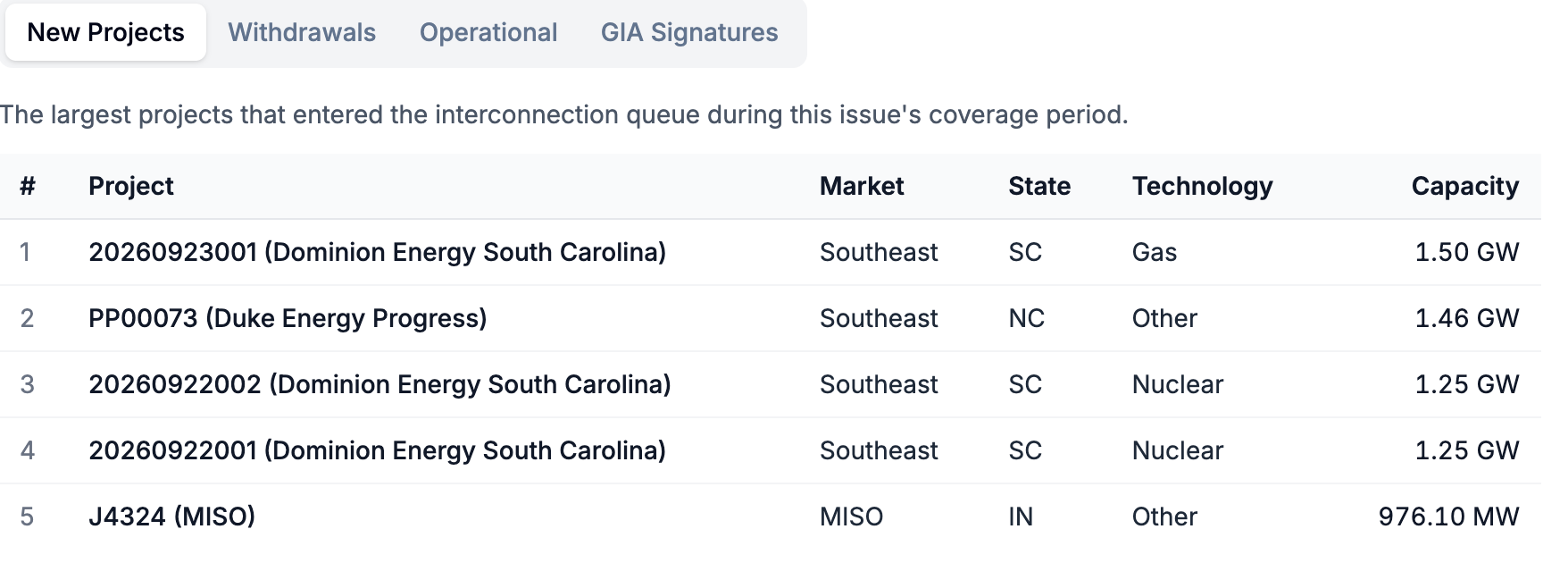
Southeast: 7.1 GW (24 requests). Dominion Energy South Carolina’s 2026 cluster added 5.7 GW.
PJM: 2.1 GW from the first three projects accepted into its Expedited Interconnection Track (EIT).
Non-CAISO West: 500 MW; SPP: 170 MW.
By resource type (for requests that reported a fuel type): battery 6.9 GW, gas 5.6 GW, and nuclear 2.5 GW. About 17 GW (mostly MISO’s DPP-2026 requests) does not yet include a fuel type. We will report fuel types as they become available.
Withdrawals: 8.00 GW (38 projects)
Non-CAISO West: 3.4 GW (15 projects).
Southeast: 1.9 GW, led by two Duke Energy Progress provisional requests in Anson County, NC (990 MW and 495 MW; no fuel type).
NYISO: 1.1 GW, including two 380 MW wind requests that entered C26 in late July 2026.
MISO: 613 MW; CAISO: 350 MW; PJM: 419 MW; ISO-NE: 196 MW; SPP: 65 MW.
By resource type: solar+battery 2.2 GW, solar 1.4 GW, battery 1.1 GW, wind 1.1 GW, and gas 450 MW.
Other Activity:
GIAs: 14 projects, 2.45 GW. Southern Company accounts for about 1.15 GW across eight solar, solar+battery, and battery projects in Alabama and Georgia. SPP accounts for about 435 MW. Two BPA records (820 MW) also moved to executed status, though both still list proposed in-service dates of 2018 and 2021.
Newly operational: 4 projects, 1.13 GW. Most of this total comes from Revolution Wind, the 704 MW offshore wind project off Rhode Island, which reached in-service status in ISO-NE’s queue on October 14.
Suspended: 6 projects, 1.40 GW.
Policy Watch
In the News & On the Docket
MISO’s plan to clear its last legacy queue cycle. In comments filed October 5, the Organization of MISO States tentatively supported MISO’s proposal to accelerate DPP-2022, which still holds about 72 GW of active requests. The proposal would give DPP-2022 projects a one-time opportunity to withdraw penalty-free before the cycle’s October 20 decision point. The proposal would also raise the network upgrade cost increase that allows a penalty-free exit later in the process from 35% to 50%. For all cycles, MISO would limit the final study phase to one restudy. MISO says that without these changes, DPP-2022 would likely be delayed at least 18 months. At least one developer raised concerns that the higher threshold shifts financial risk onto projects that remain in the queue. (Docket ER26-3813-000)
DOE urges PJM to protect existing ratepayers in its backstop procurement. On October 7, DOE filed a notice of intervention and statement of position backing the concerns FERC raised when it ordered further proceedings regarding PJM’s Reliability Backstop Procurement proposal last month. DOE asked PJM to revise its cost allocation so that large loads, rather than existing customers, pay for the new capacity they require. It also asked PJM to use updated load forecasts and to track whether large-load projects come online, are delayed, or are canceled. DOE is pushing PJM to submit a revised proposal by October 29. Two days later, FERC separately rejected the core of PJM’s large-load interconnection proposal, Interim Resource Adequacy Service (IRAS), while accepting its 50 MW large-load definition and registry. (Dockets ER26-3380-000 and EL26-108-000; IRAS: ER26-3515-000)
MISO introduces a fast-track study process for large loads paired with new generation. On October 2, MISO filed its Large Load Addition Resource Study (LARS), which would study a new load of 200 MW or more alongside new generation contracted to serve it in the same local resource zone, completing both studies in about 120 days. This proposal is, in part, a response to FERC’s June “show cause” order on large-load interconnection, and MISO asked for a December 2 effective date so the first study can begin in early 2027.
Activity Map
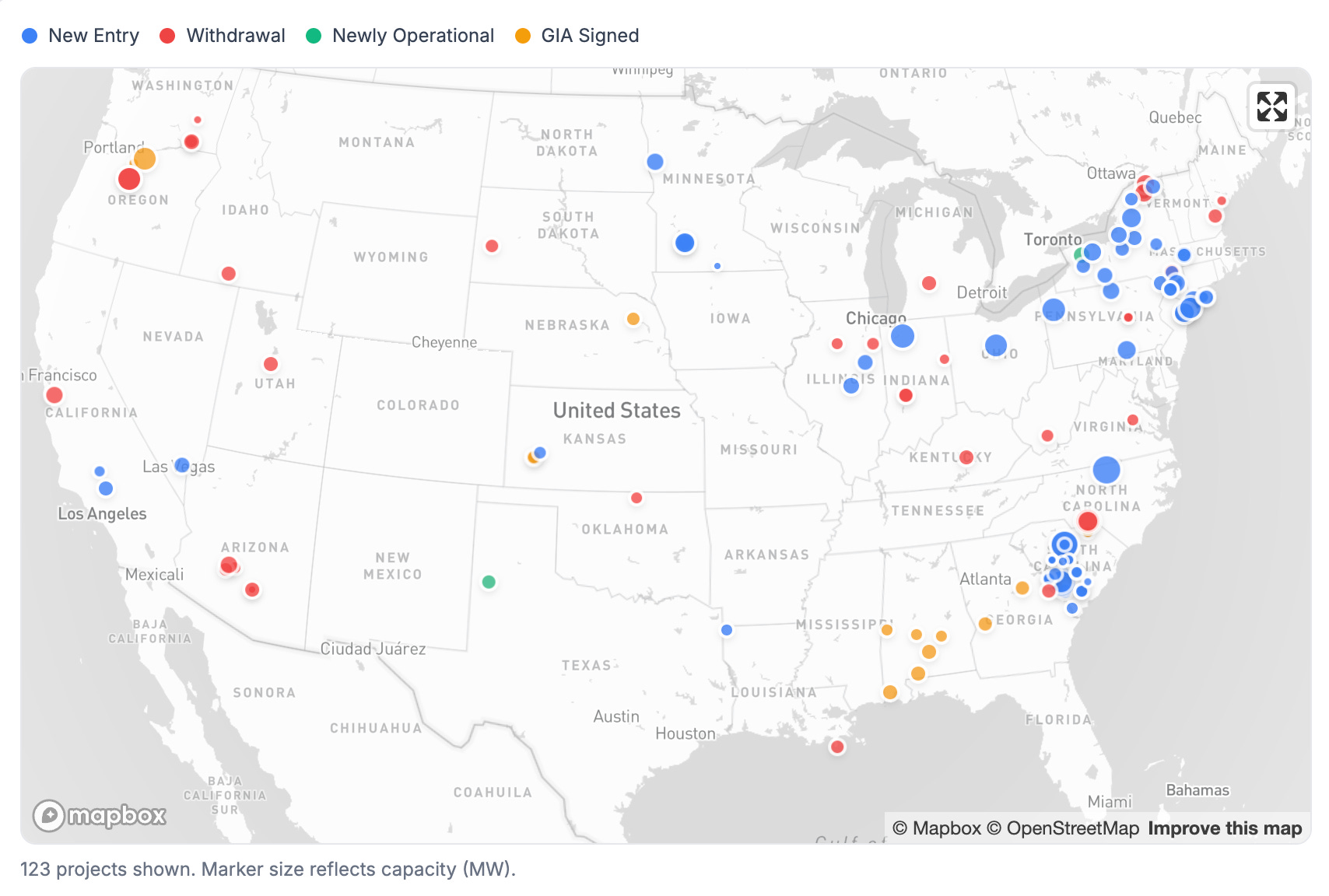
Over the last two weeks, we’ve seen mostly new requests entering the queues. Most of the visible activity is in three regions:
New York. Requests from NYISO’s C26 cluster are spread across the state. Downstate, there are about 2.1 GW of gas requests in Brooklyn and on Long Island (Nassau and Suffolk counties) and about 1.2 GW of battery requests. Five battery requests totaling nearly 800 MW cluster in the Hudson Valley in Orange and Ulster counties. Upstate, about 2.6 GW of new requests, mostly batteries, are spread from Lake Ontario (Oswego and Monroe counties) through central New York (Onondaga, Oneida, and Montgomery counties) and to the north (Lewis, St. Lawrence, and Clinton counties).
South Carolina. Dominion Energy South Carolina’s cluster accounts for most of the activity in the state. It includes two nuclear requests (2.5 GW total) at the V.C. Summer site in Fairfield County and two gas requests (2.25 GW) at the Savannah River Site in Barnwell County, as well as smaller gas and solar+battery requests at existing substations across the state.
North Carolina. Duke Energy Progress posted a 1.46 GW request in Person County and withdrew about 1.5 GW in Anson County. Both appear to be provisional records tied to gas requests already in Duke’s queue, rather than new projects or exits.
PJM added three Expedited Interconnection Track (EIT) projects in northwest Pennsylvania (Crawford County), north-central Ohio (Morrow County), and south-central Pennsylvania (Adams County). MISO’s 15.8 GW of new requests is again largely missing from the map, as only a handful of DPP-2026 records include coordinates so far.
Withdrawals are scattered, but are mostly across the West, and include two 800 MW Portland General Electric requests in central Oregon, BPA requests near the Tri-Cities in Washington, and six Arizona Public Service requests, as well as smaller exits in southern Idaho, central Utah, western South Dakota, and the San Jose area. In the eastern U.S., withdrawals include two wind requests in northern New York near the Canadian border and a handful of smaller, older solar and wind projects in Pennsylvania, Virginia, West Virginia, Indiana, and Illinois.
Queue Activity
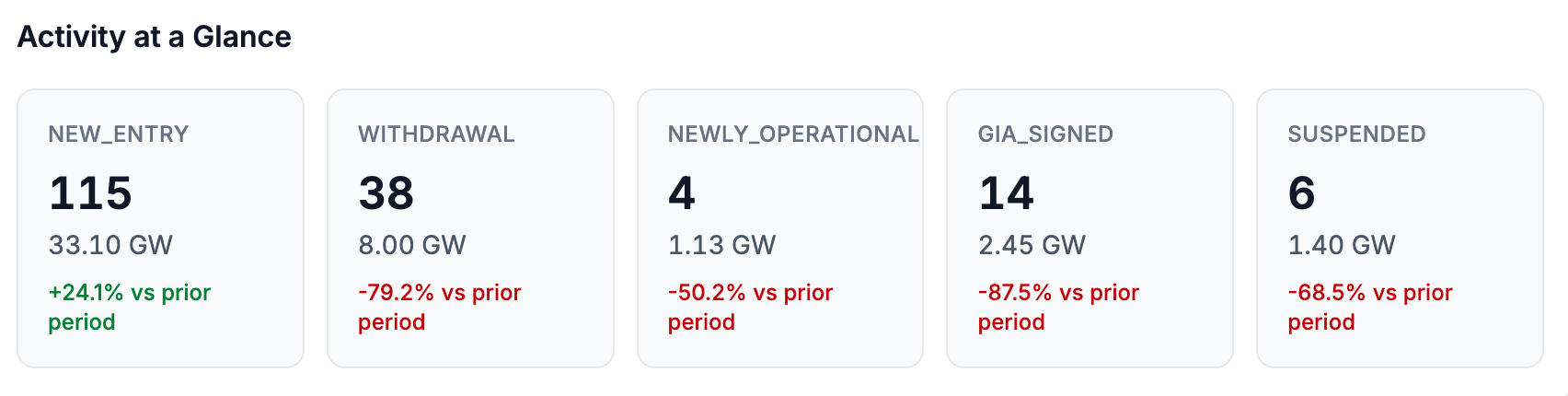
About 33 GW entered the queues and about 8 GW withdrew in early October, for a net gain of roughly 25 GW. The 33 GW of new additions to the queues is the largest influx we’ve seen since PJM’s Cycle 1 data release in early August. Withdrawals fell to roughly a quarter of the prior period’s 30 GW. As usual, a few data releases drive the totals. Three cluster windows account for about 86% of new capacity: MISO’s DPP-2026 (about 16 GW), NYISO’s C26 cluster (about 7 GW), and Dominion Energy South Carolina’s 2026 cluster (about 6 GW).
As previously noted, MISO’s 50 new DPP-2026 requests do not currently report a fuel type, so the “Other” category again comprises most of the new additions this period. Among requests that do report a fuel type, battery storage leads at about 7 GW, most of it 4-hour duration systems in NYISO’s C26 cluster, along with PJM’s two EIT battery projects. Gas trails at about 5.6 GW, split mainly between New York, where most requests are in New York City and on Long Island, and South Carolina. The two 1,250 MW nuclear requests at V.C. Summer adds another 2.5 GW.
Withdrawals this period were relatively light and spread across multiple utilities and ISOs. The largest exits appear to be data housekeeping rather than recent developer decisions. Portland General Electric withdrew two 800 MW solar+battery requests in central Oregon whose proposed in-service dates had already passed in 2025, and Duke Energy Progress withdrew about 1.5 GW of provisional requests in Anson County, NC.
Several smaller exits look more like recent developer decisions. In New York, two 380 MW wind requests and a 250 MW battery withdrew from NYISO’s C26 cluster within about 11 weeks of entering the queue. In MISO, two 150 MW Duke Energy Indiana solar projects withdrew from the DPP-2022 cycle around its October 20 decision point. DPP-2022 is MISO’s last legacy queue cycle, and MISO has asked FERC to let its projects exit penalty-free before that date (see In the News above). The two projects were allocated about $710/kW and $350/kW in network upgrades.
New operational capacity totals about 1.1 GW, but only Revolution Wind, a 704 MW offshore wind farm off the coast of Rhode Island, came online between October 3 and 16. It reached in-service status in ISO-NE’s queue data on October 14. The rest reflects lagged updates to a 280 MW solar project in western New York and a 150 MW solar project in the Texas Panhandle that reached commercial operation in April.
Fourteen projects totaling about 2.45 GW moved to IA executed status. Southern Company accounts for nearly half, with eight solar, solar+battery, and battery projects in Alabama and Georgia (about 1.15 GW), most of them queued in April 2025. SPP added 435 MW, including two wind projects in southwest Kansas that signed IAs about three years after entering the queue.
Queue Snapshot — Current State
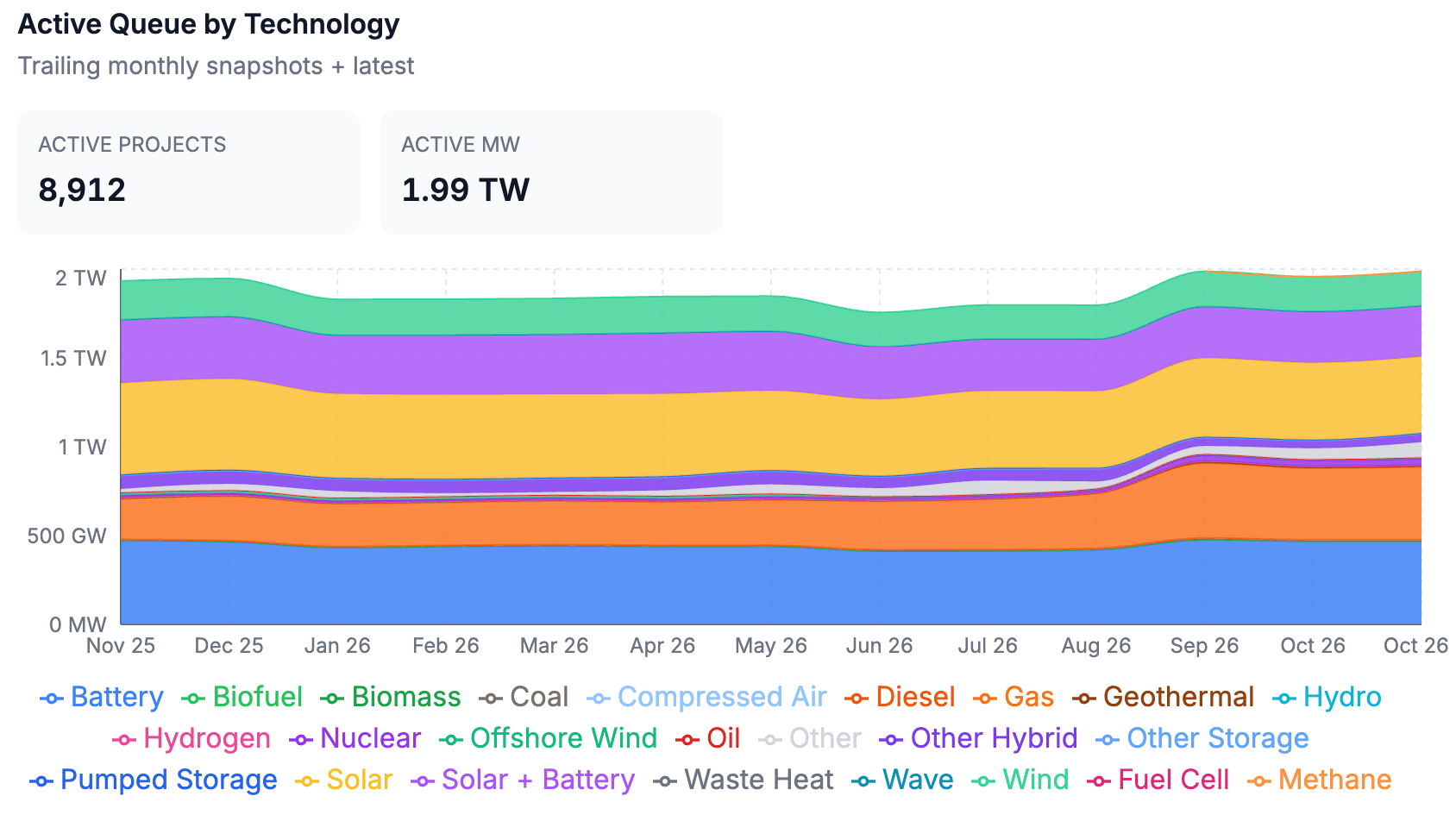
Active capacity stands at 1.99 TW across 8,912 projects, up about 30 GW and roughly 60 projects from our last edition. Five technologies still make up about 90% of active capacity: battery at about 468 GW, solar at 430 GW, gas at 409 GW, solar+battery hybrids at 286 GW, and wind at 193 GW.
Gas rose about 7 GW over the past two weeks, recovering part of the decline we reported last edition. Most of that comes from new gas requests in New York and South Carolina, and it narrowed the gap between solar and gas to about 21 GW from roughly 32 GW. Gas is up about 81% year over year. Nuclear rose to about 36 GW (up 244% year over year), with the two V.C. Summer requests (2.5 GW) accounting for the entire increase this period.
Regional Breakdown by ISO/RTO
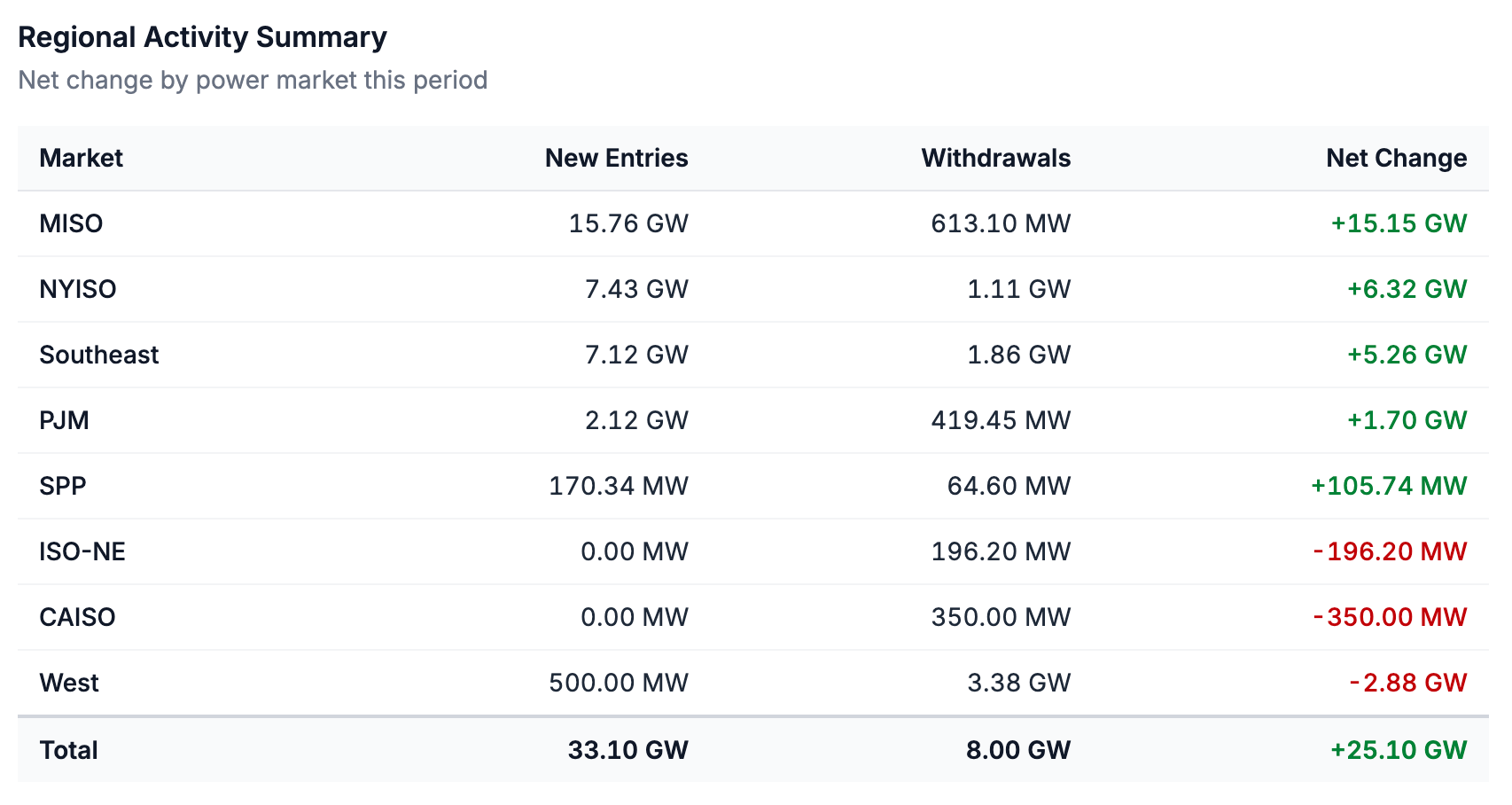
MISO had the largest net change this period, adding about 15 GW. All 50 new requests come from the DPP-2026 application window, which now totals about 238 active requests and 81 GW, up from roughly 189 requests and 67 GW two weeks ago. MISO’s standing queue has climbed steadily since August and is now above 400 GW, closing in on ERCOT and the non-CAISO West. As noted above, MISO is also working to clear the backlog from its oldest cycle, DPP-2022, which still holds about 380 active requests (roughly 72 GW), even as its newest cycle continues to grow.
NYISO posted a net increase of 6.3 GW, nearly all of which came from additions to its C26 cluster. Including requests from earlier updates, C26 now holds about 49 active requests totaling 11 GW: roughly 7 GW of battery storage, 3 GW of gas, and 1 GW of other resources. Another 21 cluster requests have already been withdrawn. NYISO’s active queue has grown by about 60% since August, though at about 42 GW it remains one of the smallest queues among the ISOs we track.
The Southeast posted a net increase of 5.3 GW, mostly from Dominion Energy South Carolina’s 2026 cluster (about 5.7 GW across 23 requests). PJM added about 2 GW, its first new requests since the Cycle 1 entries. All three new requests entered through PJM’s Expedited Interconnection Track (EIT), which we discuss in more detail below. PJM’s Cycle 1 requests were unchanged this period.
The non-CAISO West posted a net decline of about 2.9 GW. That is mostly the two Portland General Electric records, six Arizona Public Service requests (about 820 MW), and a handful of smaller exits in Washington, Idaho, Utah, and South Dakota, partly offset by 500 MW of new LADWP storage requests. CAISO lost a 350 MW battery project with an executed agreement, ISO-NE lost about 200 MW, mostly a 180 MW solar project in southern Maine, and SPP saw a small net gain.
Notable Projects
This period’s data gives us another look at how both sides of the queue are trying to move faster. Grid operators continue to add fast-track processes for new capacity, and developers increasingly appear to favor existing plant sites, upgrades, and uprates, which can shorten the path to service. Both approaches respond to the same pressure: getting new capacity online quickly enough to keep pace with growing demand.
PJM accepted the first three projects into its Expedited Interconnection Track (EIT) on October 8. Two are ENGIE battery projects: 860 MW in Crawford County, Pennsylvania, and 800 MW in Morrow County, Ohio. The third is LS Power’s 455 MW gas uprate at its existing Hunterstown combined-cycle plant in Adams County, Pennsylvania. FERC approved EIT in June as a temporary process to study up to 10 projects a year that can (1) come online within about three years and (2) have support from their state’s siting authority. All three projects are targeting mid-2029 CODs. Unlike the SPP fast-track agreements we covered last edition, which were mostly gas, about 80% of PJM’s first EIT capacity is battery storage.
In New York, much of the new gas capacity in NYISO’s C26 cluster is at existing plant sites. About 2.1 GW of gas requests are at the Gowanus generating facility in Brooklyn, the E.F. Barrett plant in Nassau County, and the Northport plant in Suffolk County, including a repowering of Gowanus’s existing gas turbines. Several of the cluster’s larger battery requests are at the same or nearby substations in Brooklyn, Queens, and Staten Island.
New nuclear requests are relatively rare in the queue data. This period, Dominion Energy South Carolina’s cluster added two 1,250 MW nuclear requests at the V.C. Summer switchyard in Fairfield County, with proposed in-service dates at the end of 2031 and 2032. The records do not identify the interconnection customer, but the switchyard is expected to serve the two unfinished AP1000 units, which Santee Cooper owns and is working to complete with Brookfield.
Want to go deeper? GridTracker users get access to:
Project-level insights (see the project-level changes that occur in real-time)
Exportable datasets (export the full list of newly operational, withdrawn, GIA-signed, and added projects)
Interactive graphs and visualizations
Custom dashboards with real-time alerts and data export
Exclusive in-depth industry reports
… and much more!
Hi Nick, Chris and Steven,
I write Delivery Dates Research. We take the delivery and energization dates that data-center operators and miners file with the SEC and check them against what their later filings say. Basically, it's a receipt drawer for the build-out.
Your Oct 23 queue update tracking a new fast-track for load in MISO is the large-load side of the same story we follow from the filings end.
I've added Interconnection.fyi to our recommendations because it fits our readers. If ours fits yours, a recommendation back would be great, but there's no obligation. Either way, I'll keep reading.
Delivery Dates Research
hello@deliverydatesresearch.com
PJM's Expedited Interconnection Track got 2.1 GW from its first three projects. How will you judge whether EIT is actually faster: time to a signed GIA, or time to in-service? Those two BPA records still listing 2018 and 2021 in-service dates make me trust only the second.