


Executive Summary
The following entities updated their queue data this period: NYISO, MISO, PJM, SPP, ERCOT, CAISO, ISO-NE, PacifiCorp, Portland General Electric, Black Hills Colorado Electric, Southern Company, Duke Energy Progress, LG&E and KU, and Tampa Electric.
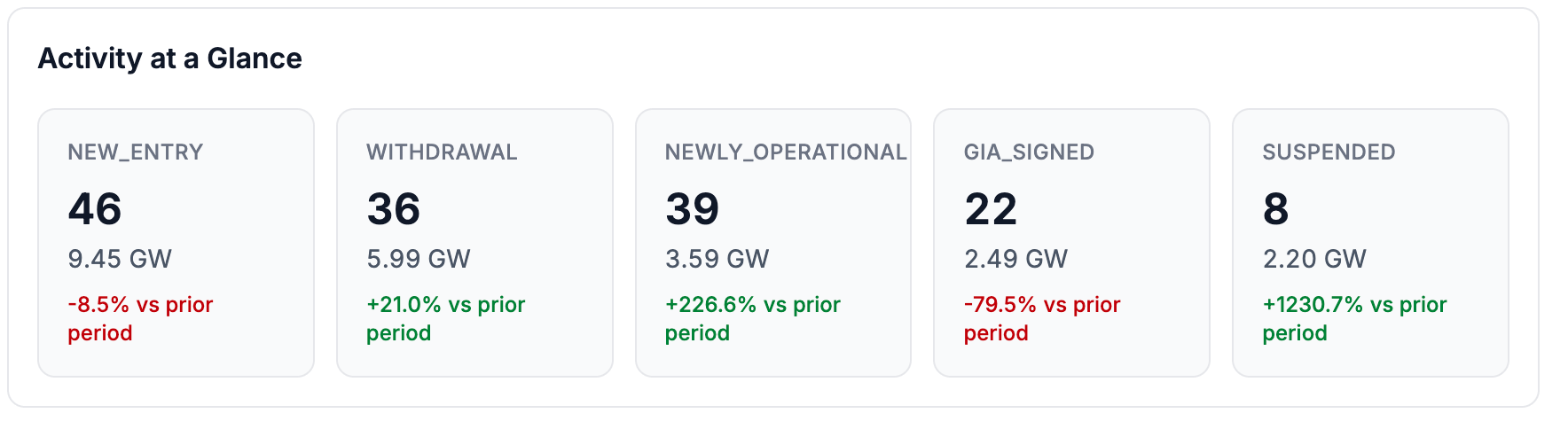
Additions: 9.45 GW (44 projects)
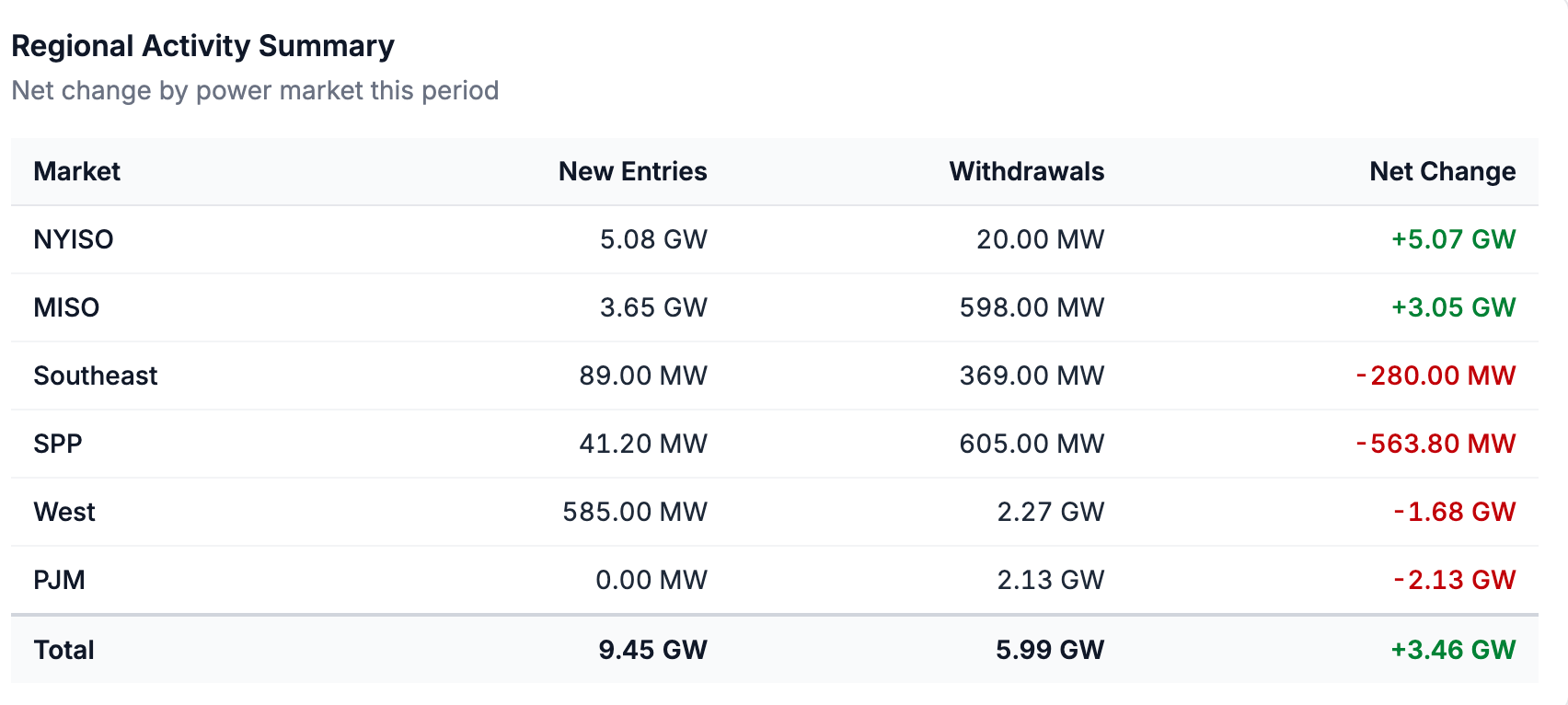
NYISO: 5.1 GW across 25 requests, all from their 2026 cluster (C26).
MISO: 3.7 GW across 14 requests. Twelve of these are early DPP-2026 requests that do not yet disclose fuel type (DPP-2026 application cycle closes on January 15, 2027)
West (non-CAISO): Two PacifiCorp gas requests totaling 585 MW.
Southeast: 89 MW; SPP: 41 MW.
By technology: battery 2.8 GW, gas 1.3 GW, wind 1.1 GW, solar 540 MW and solar+battery 130 MW.
The average size of newly added projects this period is about 215 MW.
Withdrawals: 5.99 GW (33 projects)
West (non-CAISO): 2.3 GW across 10 projects.
PJM: 2.1 GW across eight projects, including a 1.3 GW gas request from Cycle 1.
SPP: 605 MW; MISO: 598 MW; Southeast: 369 MW; NYISO: 20 MW.
By technology: gas 1.6 GW, wind 1.4 GW, solar 940 MW, a 750 MW solar+wind+battery hybrid, battery 740 MW, and solar+battery 570 MW.
Average project size: about 180 MW.
Other Activity:
21 projects executed GIAs this period totaling 2.3 GW. Twelve of these are from Southern Company (1.3 GW), including six nuclear uprate requests at Plants Hatch and Vogtle.
27 projects (3.6 GW) show up as newly operational. Roughly 2.0 GW of that reached commercial operation in August or September. The rest reflects delayed status updates from ISOs/utilities dropping in our data.
Policy Watch
In the News
PJM opens its 6 GW reliability backstop auction on Sep 30. PJM’s 2028/2029 capacity auction earlier this summer fell 6,831 MW short of the reliability requirement. The bid window for its Reliability Backstop Procurement will open on September 30th and run through October 21st, with results due by December 2nd.
The House passed the Ratepayer Protection Act (H.R. 9340) 417–3 on Sep 16. The bill requires states to consider standards so that loads over 100 MW pay the full incremental cost of grid infrastructure. The path for this bill to become law before the midterms is unclear, and the Senate is not expected to act before the midterm elections.
Virginia continues to grapple with data centers. On September 14th, Dominion and NextEra revised their $67B merger commitments in response to concerns from stakeholders, and doubled the duration of $10 bill credits for residential customers from two to four years. The Virginia State Corporation Commission (SCC) also mandated three in-person hearings across Dominion’s Virginia service area that will offer residents the opportunity to weigh in on the proposed merger. Separately, in late August, Microsoft filed a notice of appeal to preserve its challenge to the SCC’s July 31st order requiring data centers to pay upfront for direct-connect transmission.
On the Docket
MISO’s “zero injection” interconnection proposal draws broad support. MISO filed a Zero Injection Generator Interconnection Agreement (ZGIA) framework on Aug 18. It creates a 90-day study path for generators that serve large or co-located loads at the same substation and voltage. The proposal places limits on eligible projects: interconnection service cannot exceed the associated load’s peak demand, projects cannot require network upgrades beyond the substation (other than protection equipment), and each study cycle accepts only the first ten requests. This is MISO’s first filing responding to FERC’s large-load show cause order. (Docket No: ER26-3552-000)
Xcel Energy’s Southwestern Public Service Company (SPS) seeks approval for 570 MW of batteries using surplus interconnection rights. SPS is seeking Texas PUC approval of six battery storage purchase agreements with NextEra. The 570 MW of projects are co-located with existing NextEra renewable plants. Xcel/SPS want to use surplus interconnection rights to avoid SPP’s lengthy study process and high network upgrade costs. The Office of Public Utility Counsel (OPUC) in Texas, and others, want a large-load tariff that would require new loads of 50 MW or more to build, buy or bring their own generation. Initial briefs were filed on September 16th and 17th. (Docket No: PUCT 59034; SOAH 473-26-15924)
Good Reads
There is so much quality research coming out related to interconnection, large loads, and all things energy/the grid. Here is a non-exhaustive list of everything I’ve been reading (or, at the very least, bookmarking and planning to read).
Luminary Strategies (Arushi Sharma Frank) released a detailed explainer of ERCOT’s Provisional Controllable Load Resource (PCLR) construct, which enables large loads to energize ahead of the transmission upgrades it would otherwise wait on. Rather than treating a data center as a fully firm obligation, the framework splits it into a firm planning floor and a larger dispatchable range that clears through nodal SCED, which makes batteries, onsite generation, and workload flexibility a way to buy speed to power.
The Grid 2.0 Task Force published RFC #1, a draft protocol specification that would let large loads, batteries, and renewable assets voluntarily broadcast tiered flexibility requests each minute and receive proportional grid access in return, with the aim of unifying the one-off flexible connection structures now emerging separately in ERCOT, PJM, and SPP.
A recent GridLab report on how California could use flexible demand, especially EV charging and discharging on the utility’s signal, to hold down rates while keeping the grid reliable.
Berkeley Lab (LBL) and Brattle Group’s annual survey of large-load tariffs, discussing which terms utilities are converging on for data centers and other large customers.
A study from Tyler Norris and researchers at Duke and LBL about whether energy-only interconnection service (ERIS) actually delivers a cheaper or faster path to the grid.
An analysis by Piq Energy, using Base Power’s distributed battery fleet, testing whether coordinated dispatch of small batteries can free up enough room on the grid to connect a large new load without curtailment.
An MIT CEEPR working paper measuring how much data center growth has raised retail electricity rates, and which customers and which kinds of utilities have absorbed the increase.
Activity Map
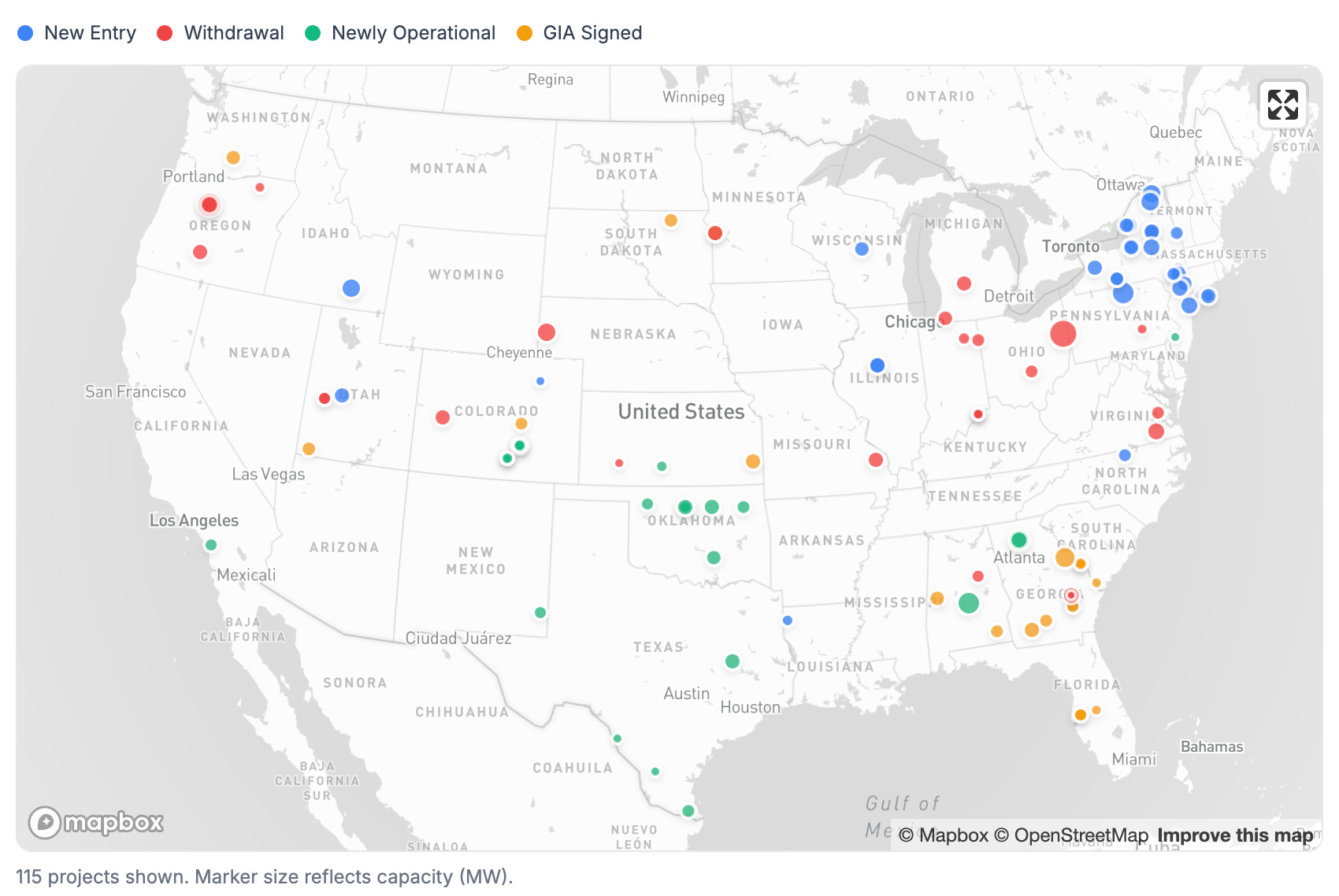
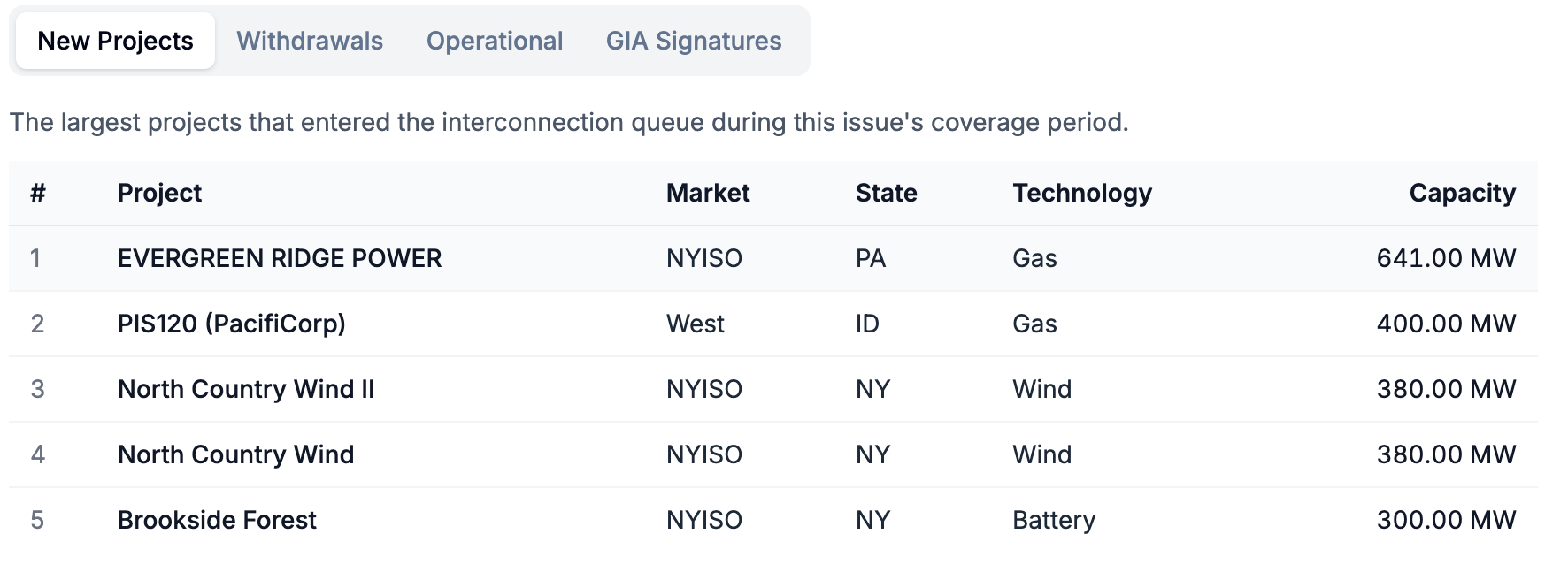
New York accounts for most of the new queue activity this period, with two main clusters of additions in the region:
Battery storage requests along the Hudson Valley, in Ulster, Dutchess and Orange counties, totaling about 1.2 GW. Nearly all of these requests are four-hour battery storage systems.
A pair of 380 MW wind requests in Franklin and Clinton counties, near the Canadian border.
Smaller storage projects on Long Island (Queens and Suffolk County) round out the activity in the state. MISO’s 3.7 GW of new requests this period is underrepresented on the map, because most of its DPP-2026 entries do not yet include a county or coordinates.
Withdrawals are scattered this period, with only one clear concentration in central Oregon, where five PGE requests totaling 1.75 GW withdrew from the Mountain View 500 kV substation in Jefferson County. Two smaller PacifiCorp also withdrew, in Lake and Umatilla counties bringing total withdrawn capacity in the region to about 2 GW. The largest exit from the queues this period is a 1.3 GW gas request from PJM in Columbiana County, Ohio.
Projects reaching commercial operation and signing GIAs cluster in Georgia, Alabama and Oklahoma. In Georgia and Alabama, Southern Company accounts for three newly operational projects (about 1.5 GW of battery and gas) and 12 executed GIAs (about 1.3 GW, led by battery storage and nuclear uprates). In Oklahoma, several of the projects newly marked operational in our data share a single SPP substation. More on that below.
Queue Activity
This was the second consecutive quiet period for the queues. About 9.5 GW entered the queues and just under 6 GW withdrew, for a net capacity increase of roughly 3.5 GW. The period from Aug 8th - 21st saw 23 GW of new requests and 56 GW of withdrawals, while the Aug 22nd - Sep 4th period landed closer to 10 GW and 5 GW of new additions and withdrawals, respectively.
Two queue data updates account for nearly all of this period’s new requests:
NYISO posted 25 requests from its 2026 cluster, totaling 5.1 GW.
MISO posted 14 requests totaling 3.7 GW, most of them early entrants into its DPP-2026 cycle.
The technology mix this period is not quite as informative as usual. MISO has not yet disclosed fuel types for requests in the DPP-2026 application window, so about 3.6 GW of this period’s additions carry no technology label and are currently labeled as “Other,” though we expect MISO to update their underlying data as they process additional DPP-2026 requests. Among requests with a disclosed fuel type, battery storage led the way at 2.8 GW, with gas at 1.3 GW, down sharply from the 8.4 GW of new capacity added between Aug 8th and Aug 21st. The queues also added 1.1 GW of wind. With MISO’s fuel types still unknown, we would not read the gas decline as a shift in recent trends in gas requests.
Gas accounts for the largest share of withdrawals at 1.6 GW, but a single 1.3 GW PJM request accounts for most of that total. Renewables and storage made up roughly three-quarters of withdrawn capacity, consistent with the pattern we have tracked all year.
More notable is how far along some of the existing projects were. About 830 MW of withdrawn capacity had executed interconnection agreements including five PJM solar projects that entered the queue between 2018 and 2020, and two MISO wind projects that signed GIAs in 2021 and 2022.
Looking at the projects that came online this period, we see 3.6 GW reaching commercial operation, but only about 2.0 GW did so during August or September. The rest of the capacity that changed COD status this period comes from utility/ISO data updates, including about 1.0 GW of SPP projects that have online dates between May 2025 and April 2026 and 590 MW of plants in Black Hills Colorado Electric built between 2011 and 2020.
Queue Snapshot — Current State
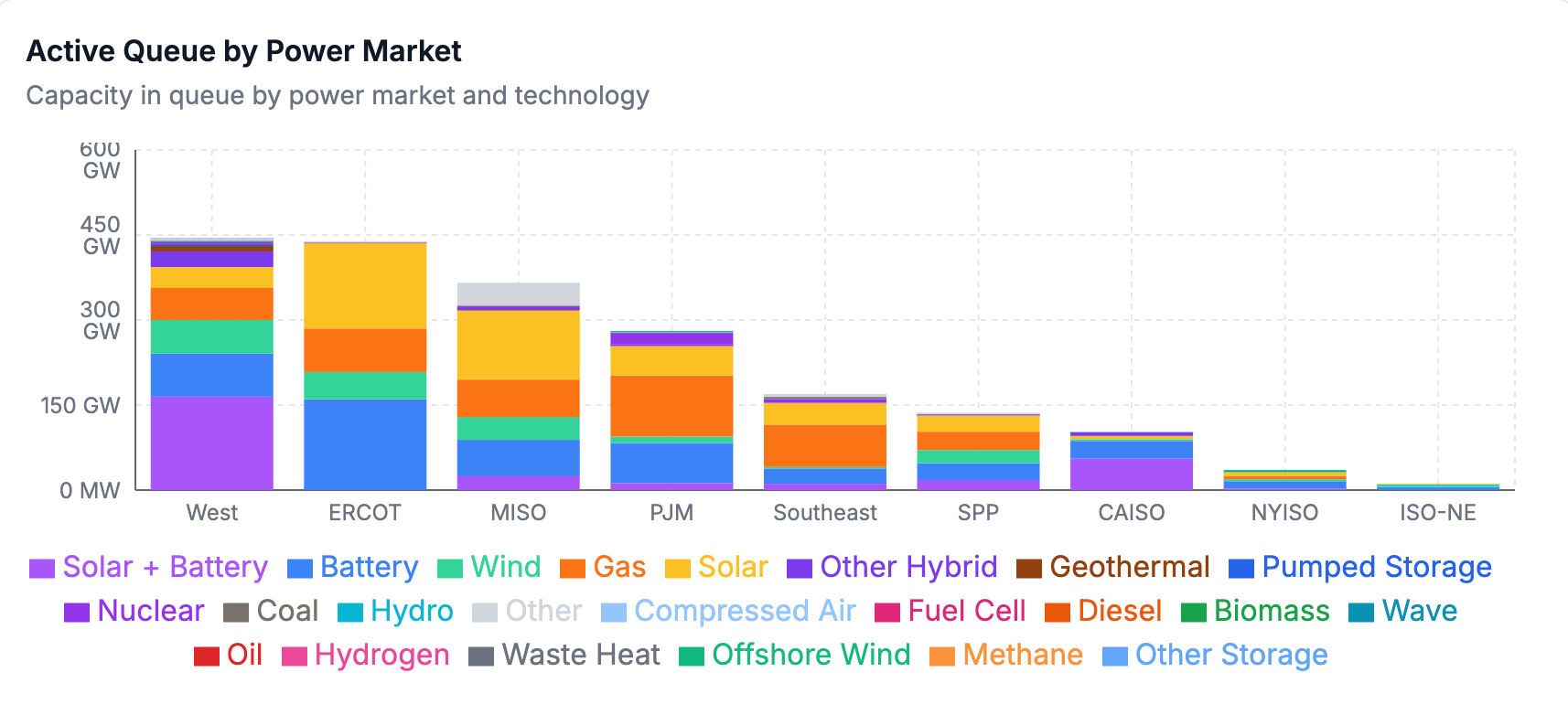
Active capacity stands at 1.98 TW across 8,993 projects, essentially flat over the last 6 weeks. The national queue remains just below the 2 TW mark it crossed briefly after PJM’s Cycle 1 release.
The composition of the queue barely moved this period. Five technologies still make up roughly 92% of active capacity: battery at about 477 GW, solar at 442 GW, gas at 419 GW, solar+battery hybrids at 288 GW and wind at 196 GW. The queues added about 10 GW of battery capacity over the past month and about 5 GW of gas, while solar was flat and both hybrids and wind edged down.
The gap between solar and gas continued to narrow, from 27.5 GW in our August 8th - 21st edition to about 23 GW now. Over the past month, gas has gained capacity while solar has held roughly steady. Battery storage is now slightly positive year-over-year at +0.5% after sitting at -3.9% as of August 21, driven by the new requests in New York.
Other year-over-year changes are consistent with recent queue trends. Thermal and firm resources continue to add capacity compared to 2025, with nuclear up about 250% to 33 GW, coal up roughly 130% to 7.5 GW, gas up about 117%, and geothermal up about 104% to 9.7 GW. Renewables continue their decline, with offshore wind down 63%, solar plus battery down 19%, solar down 13% and wind down 12%.
Regional Breakdown by ISO/RTO
Now let’s dig into recent changes by ISO and utility. NYISO posted the largest net gain this period, roughly 5 GW, bringing its active queue to about 36 GW. All 25 new requests are from its 2026 cluster. The fuel mix of these new requests skews heavily toward storage, and includes about 2.8 GW of battery requests, most of them four-hour systems ranging from 100 to 300 MW, along with two 380 MW North Country wind requests and a 199 MW wind project in Wyoming County, as well as about 530 MW of solar. The lone gas request in NYISO’s 2026 cluster is a 641 MW project located in Pennsylvania.
MISO added 3 GW of net capacity this period Its DPP-2026 cycle now includes 160 active requests totaling about 56 GW across its subregions. This period’s 14 requests are an incremental addition to that cycle, led by a 1 GW Ameren Missouri request. MISO’s three withdrawals were all older projects from the 2017 to 2020 study cycles, two of which had already signed GIAs.
PJM recorded no new requests and 2.1 GW of withdrawals composed of three Cycle 1 projects that entered in April and exited in September, including a 1.3 GW Ohio gas request, as well as five older solar projects that withdrew after executing GIAs. PJM’s reformed Cycle 1 has now recorded roughly 100 withdrawals totaling about 22 GW since its July data release. However, the bulk of the withdrawals (18 GW, 91 projects) withdrew before PJM publicly released data for the Cycle 1 cluster.
The non-CAISO West posted a net decline of 1.7 GW, driven by five Portland General Electric requests that withdrew at the Mountain View 500 kV substation POI in Jefferson County, OR. PacifiCorp’s two new gas requests (400 MW in Idaho and 185 MW in Utah) partially offset the region’s decline this period.
Both SPP and the Southeast posted small net declines of about 560 MW and 280 MW, respectively. The Southeast total includes five small gas requests, 17 to 19 MW each, that LG&E and KU withdrew at its Trimble County switching station. ERCOT was quiet again this period, and posted no additions or withdrawals. The non-ISO West remains the largest queue by active capacity, about 7 GW ahead of ERCOT.
Notable Projects
Existing power plants and interconnection rights continue to be a viable, and faster, path for new capacity seeking interconnection. In our Aug 8th - 21st issue, we highlighted Homer City and Merom, where developers are utilizing retired coal sites’ interconnection rights for new projects. This period, we are seeing similar developments with incremental and surplus capacity requests, and uprates at existing plants.
Six of Southern Company’s executed GIAs this period are incremental requests at Georgia Power’s Plant Hatch and Plant Vogtle, totaling about 255 MW. The requests add capacity on top of the plants’ existing interconnection service. They line up with the extended power uprates Georgia Power is pursuing at Vogtle Units 1 and 2 and Hatch Units 1 and 2, which were approved in its 2025 IRP. The company filed its latest semiannual status report on those uprates with the Georgia PSC on Sep 11 (Docket 56002). PacifiCorp also executed a surplus interconnection agreement for a 122 MW battery in southern Utah this period.
Looking at SPP’s Woodring 345 kV substation in Garfield County, Oklahoma, we can see some evidence of the shorter interconnection timelines with projects using surplus interconnection service, or capacity additions at sites with existing and excess interconnection rights.
A 250 MW solar project and a 52 MW battery at Woodring substation each took about eight years from queue entry to commercial operation.
A 200 MW battery at the same substation, requested under surplus interconnection service in 2024, reached COD in about a year and a half.
A 72 MW solar project requested under SPP’s replacement process at Southwestern Public Service’s Cunningham station reached operation in under three years.
The largest withdrawal this period is a 1.3 GW gas request in Columbiana County, Ohio. It entered PJM’s Cycle 1 in April under the name West Field Energy Center LLC and withdrew on Sep 17th. While not the first withdrawal from PJM’s Cycle, it is the first large gas project to exit the cluster. Elsewhere in PJM, two Dominion-zone battery requests (300 MW and 90 MW) from Cycle 1 also withdrew in the same week as the Ohio gas plant. The queue filings do not explain the reasons for the withdrawals, but we will continue to watch whether PJM withdrawals ramp up as Cycle 1 moves through its first study phase.
Want to go deeper? GridTracker users get access to:
Project-level insights (see the project-level changes that occur in real-time)
Exportable datasets (export the full list of newly operational, withdrawn, GIA-signed, and added projects)
Interactive graphs and visualizations
Custom dashboards with real-time alerts and data export
Exclusive in-depth industry reports
… and much more!