


Executive Summary
The following entities updated their queue data this period: MISO, PJM, SPP, ISO-NE, Tennessee Valley Authority (TVA), Southern Company, PacifiCorp, Idaho Power, NV Energy, Black Hills Colorado Electric.
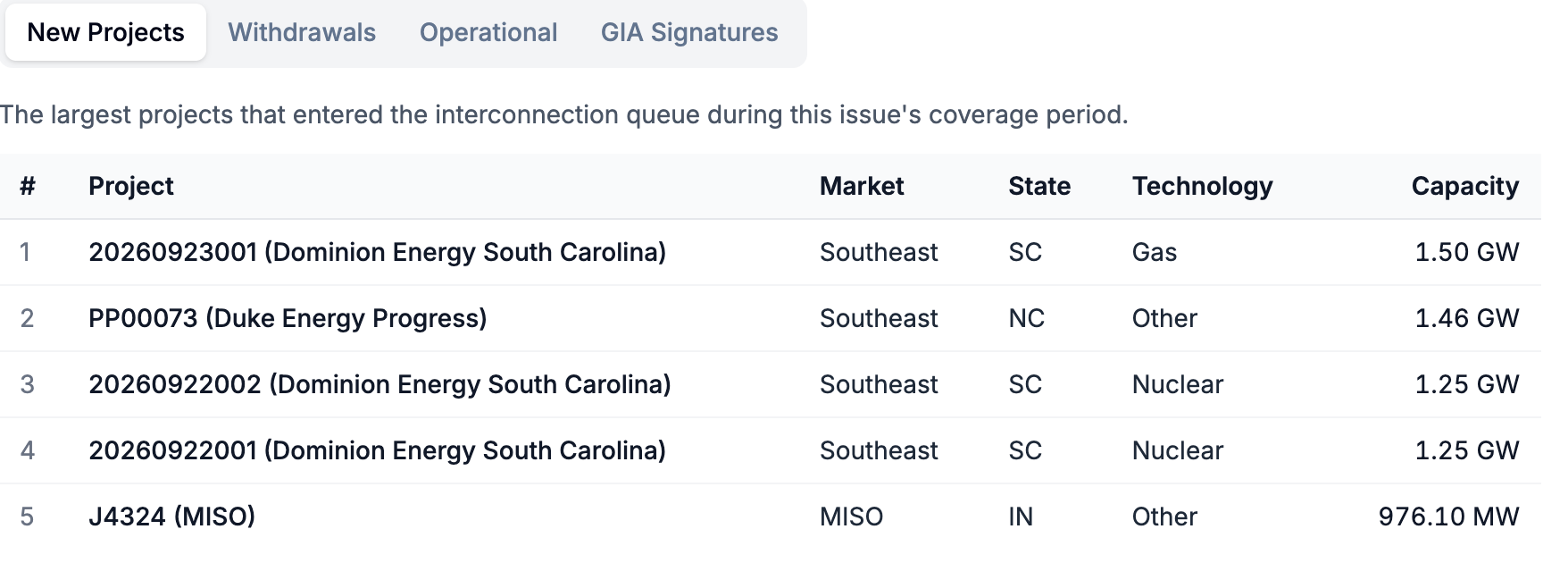
Additions: 29.5 GW (110 projects)
MISO: 25.3 GW across 94 requests. 82 are from DPP-2026 (23.4 GW, no fuel type provided). Six are Expedited Resource Addition Study (ERAS) requests (1.9 GW; see Notable Projects).
Non-CAISO West: 2.3 GW across eight requests from Idaho Power (1,280 MW) and PacifiCorp (1,056 MW).
Southeast: 1.3 GW across five TVA requests.
PJM: a 500 MW Expedited Interconnection Track (EIT) battery request.
SPP: 113 MW
By resource type (of those with reported fuel types): battery 2.5 GW, gas 2.0 GW, solar+battery 1.4 GW.
Withdrawals: 35.8 GW (204 projects)
MISO: 31.2 GW across 167 projects. 166 are DPP-2022 requests, the other is a 200 MW DPP-2020 record.
Non-CAISO West: 1.6 GW (14 requests), mostly from PacifiCorp.
ISO-NE: 1.4 GW from five Massachusetts battery requests.
PJM: 863 MW from 13 solar and battery projects queued between 2016 and 2020.
SPP: 520 MW; Southeast: 200 MW
By resource type: solar 17.5 GW, solar+battery hybrids 7.3 GW, standalone battery 5.2 GW, wind 2.6 GW, gas 1.3 GW.
Other Activity:
GIAs: 10 non-CAISO West projects (2.0 GW) now show signed GIAs in our data (9 PacifiCorp, 1 NV Energy). Most reflect earlier agreements or status updates.
Newly operational: 10 projects (2.1 GW).
Suspended: 3 projects (995 MW).
Policy Watch
In the News & On the Docket
PJM refiles its Reliability Backstop Procurement. On October 29, PJM filed a revised version of its backstop procurement for roughly 6.8 GW of capacity. FERC had suspended the original proposal in September. The biggest change is related to cost allocation. Rather than spreading costs across all customers, PJM would now charge utilities and other load-serving entities based on how much large-load growth their zone is expected to add between this past summer and the 2028/2029 delivery year. In other words, areas adding more data centers and other large loads would pay a larger share. Bidding would run from March 1 to March 28, 2027, with results posted May 10. The price cap is unchanged at $555/MW-day. PJM also says it will update the amount of capacity it seeks once its January load forecast is out, and will reduce that amount by any capacity utilities secure on their own through bilateral contracts. (Docket no: ER26-3380-000)
CAISO’s board approves large-load interconnection procedures. On October 28, CAISO’s Board of Governors approved a proposal for connecting large loads. At the core of the proposal is a “flexible interim load interconnection” that would let large loads connect to the transmission system before their associated network upgrades are finished, as long as they accept enforceable flexibility based on grid conditions. CAISO will also open a monthly window to review transmission upgrades tied to large loads outside its annual planning cycle, so transmission owners can meet FERC’s 60- to 90-day study requirement. The proposal also includes a framework to prevent cost shifting, and it would require large loads to provide hourly forecasts, telemetry and other operating data. (Docket no: EL26-71-000)
OpenAI pledges to curtail data center load during grid emergencies. OpenAI announced a “Grid Protectors Program” where the company commits to reduce electricity use at the U.S. data center campuses it develops when extreme weather or other emergencies strain the grid. The program extends an existing arrangement in Georgia. There, Georgia Power can curtail up to 1,000 MW delivered to OpenAI’s planned 3,200 MW campus in Effingham County, under a 25-year agreement the Georgia PSC approved in August. OpenAI says the terms for future sites, including how much load can be reduced, how quickly, and for how long, will be negotiated campus by campus with utilities and regulators. It has not announced any agreements beyond Georgia.
Activity Map
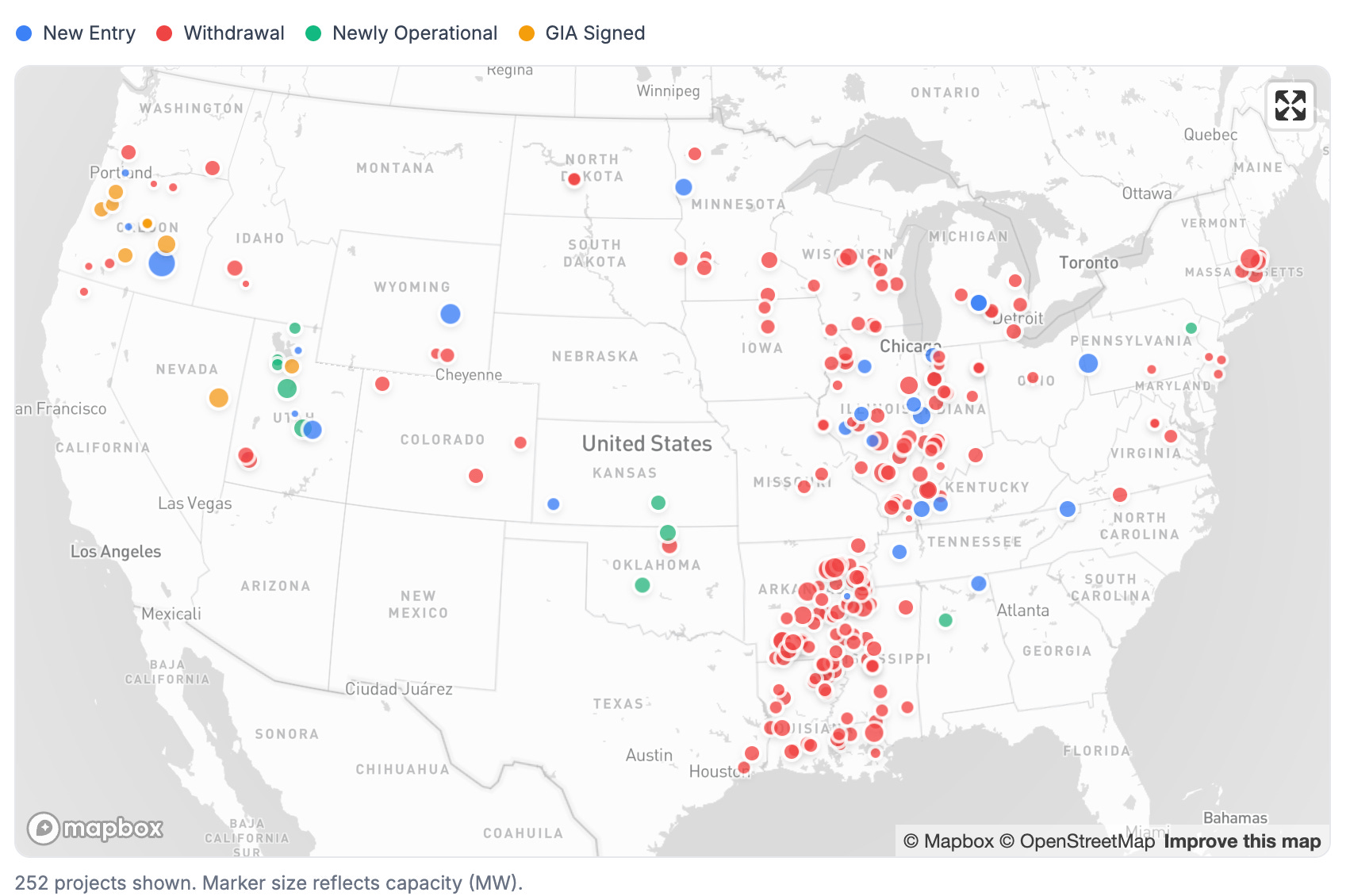
It was a big two weeks for MISO’s queue. MISO DPP-2022 cycle withdrawals dominate the map this period. They are concentrated along the lower Mississippi River valley in eastern Arkansas, Mississippi, and Louisiana. Arkansas alone lost 45 requests totaling about 10.6 GW. Further north, DPP-2022 withdrawals stretch across central and southern Illinois, Indiana, and western Kentucky, with smaller clusters in Wisconsin, Minnesota, Iowa, and Michigan.
Only a few of MISO’s new DPP-2026 requests appear on the map because most do not yet include location data. Outside MISO, the largest new requests are in the West: a 1,280 MW solar+battery request from Idaho Power in Harney County, Oregon, a 600 MW PacifiCorp gas request in Converse County, Wyoming, and a 450 MW PacifiCorp surplus gas request in Emery County, Utah. TVA added four battery requests (about 1.3 GW) in Tennessee, Kentucky, and northern Alabama. PJM’s fourth Expedited Interconnection Track (EIT) project, a 500 MW battery, is in Beaver County, Pennsylvania, near the Ohio border.
Queue Activity
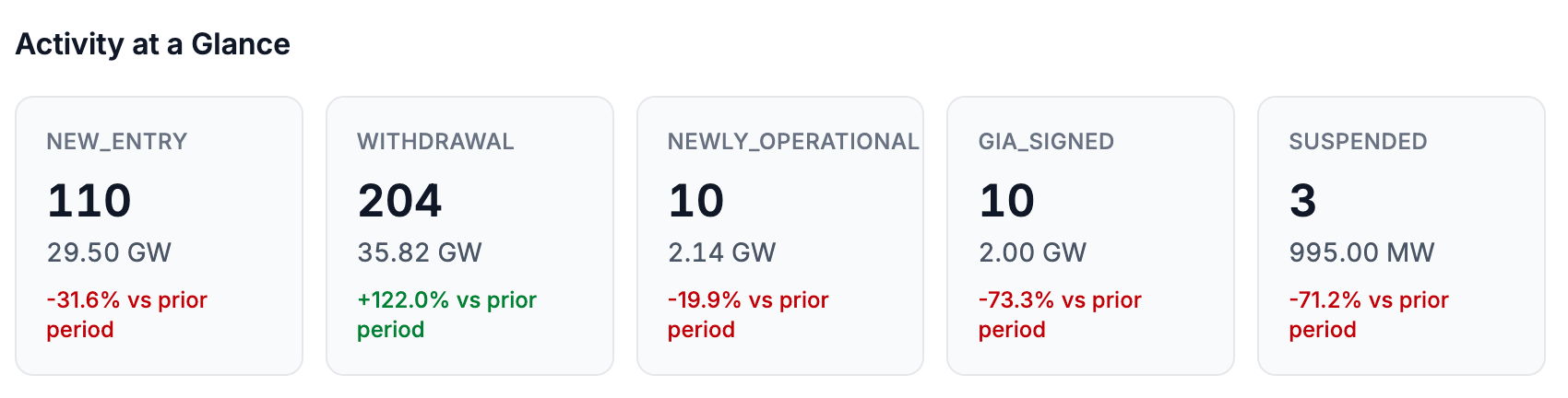
About 30 GW entered the queues and about 36 GW withdrew between October 17 and 30, for a net decline of roughly 6 GW. In the prior period, we saw 43 GW of additions and 16 GW of withdrawals in. MISO drives nearly all of the activity this period, accounting for over 80% of new capacity and withdrawals. We go into more detail on MISO additions and withdrawals this period below.
Outside MISO, activity was relatively light. New requests came largely from utilities in the non-CAISO West and Southeast, led by battery and gas requests. PJM’s fourth EIT project brings the total capacity in our data for that queue pathway to about 2.6 GW across four projects, more than 80% of which is battery storage. The largest withdrawal outside MISO was ISO-NE’s 1.4 GW across five battery requests, roughly 14% of its active queue, four of which entered the queue in mid-2024. Several other withdrawals involve older projects. PJM’s 13 exits (about 860 MW) were queued between 2016 and 2020 and already had executed agreements, and several PacifiCorp records date back to the early 2000s. The GIA and newly operational totals mostly reflect agreements and in-service dates from before this period.
MISO
MISO posted 82 more requests from its DPP-2026 application window (about 23 GW) across several data updates between October 20 and 29. As with earlier batches from this cycle, none of these new requests currently report a fuel type. DPP-2026 now holds about 320 active requests and 105 GW, up from roughly 240 requests and 81 GW two weeks ago. MISO also added six requests (1.9 GW) through its Expedited Resource Addition Study (ERAS).
DPP-2022, MISO’s last legacy queue cycle, reached Decision Point 2 (DP 2) on October 20, after Phase 2 study results had assigned each project its share of network upgrade costs. MISO’s October 28 data update showed 166 DPP-2022 requests (31 GW) as withdrawn. The records do not include withdrawal dates, but every project was at the Phase 2 stage with network upgrade cost allocations from the same September Phase 2 System Impact Study.
Heading into the decision point, DPP-2022 included 384 active requests (about 72 GW) with about $27 billion in allocated network upgrade costs. The 166 projects that withdrew account for about 43% of that capacity but nearly 80% of the costs ($20.8 billion). The 218 projects that remain (about 41 GW) account for about $6 billion in allocated upgrades. On a per-kW basis, the median withdrawn project faced about $530/kW in upgrade costs, compared with about $90/kW for projects that remained in the queue. Upgrade costs were also concentrated among a minority of projects: 71 withdrawn projects had cost allocations above $100 million each, together accounting for about $17 billion.
Looking at the interconnection cost data available via GridTracker, we see that, unsurprisingly, withdrawal rates in DPP-2022 rise steadily with cost.
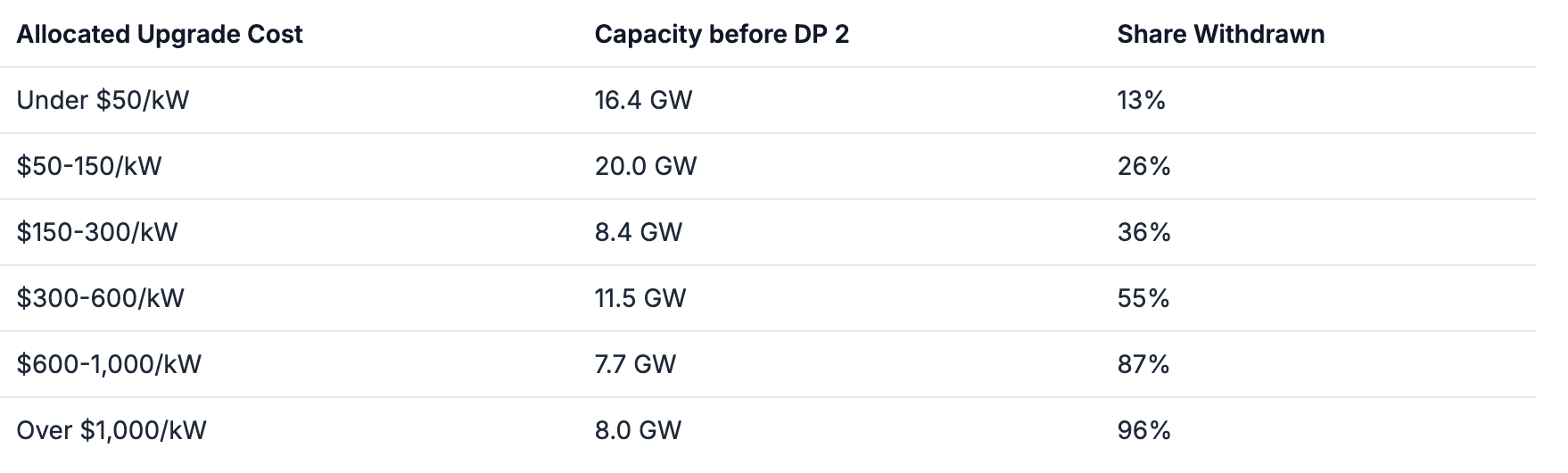
However, cost was not the only factor that contributed to developer withdrawal decisions. Even among projects with allocations under $150/kW, about a fifth of capacity withdrew, while seven projects (1.3 GW) remain in the queue despite allocations above $600/kW.
Most of the allocated upgrade costs, and most of the attrition, from DPP-2022 sit in the MISO South region. MISO South accounted for about a third of DPP-2022’s capacity before DP 2 but about three-quarters of its allocated costs ($20 billion). The median South project faced about $690/kW in upgrades, compared with about $90/kW elsewhere in MISO. Three-quarters of South capacity withdrew (93 of 121 requests), and it accounts for 60% of the withdrawn capacity. Arkansas lost 45 of 55 requests (85% of its capacity). Mississippi lost 81% and Louisiana 60%. By transmission owner, projects interconnecting to Entergy’s operating companies were allocated about 60% of DPP-2022’s total network upgrade costs (about $16 billion), and about three-quarters of that capacity withdrew. Entergy Arkansas alone accounts for 39 withdrawals (about 10 GW) and $9.2 billion in allocations. By contrast, projects in Ameren Illinois, the largest transmission owner by capacity outside of MISO South, faced less than $90/kW on average, and only 17% of that capacity withdrew.
DPP-2022 withdrawals also tended to cluster by location. Where two or more DPP-2022 projects shared a point of interconnection, they usually either all withdrew or all stayed. That pattern is consistent with the study’s practice of splitting upgrade costs among projects that share a POI. For example, three requests withdrew with a Sheridan-El Dorado 500 kV line POI in southern Arkansas (about 1.1 GW, $660 million combined). Two solar requests withdrew from the West Memphis-Keo 500 kV line (900 MW, about $470 million).
By technology, the pattern follows location more than fuel. In MISO South, about 72% of solar capacity and 85% of solar+battery capacity withdrew. Outside MISO South, solar, battery, and solar+battery withdrawal rates were each about 25%. Requests for network resource interconnection service (NRIS) in MISO South withdrew at a higher rate (83% of capacity) than energy-only (ERIS) requests (64%). They also carried higher allocations (about $940/kW versus $690/kW), likely reflecting the added deliverability upgrades that come with that service.
The 218 remaining projects (about 41 GW) are spread more evenly across MISO’s subregions/study groups: Central (16 GW), West (9 GW), East-ITC (8 GW), South (6 GW), and East-ATC (2 GW). The MISO South projects that remain still carry relatively high costs, about $400/kW on average.
Queue Snapshot — Current State
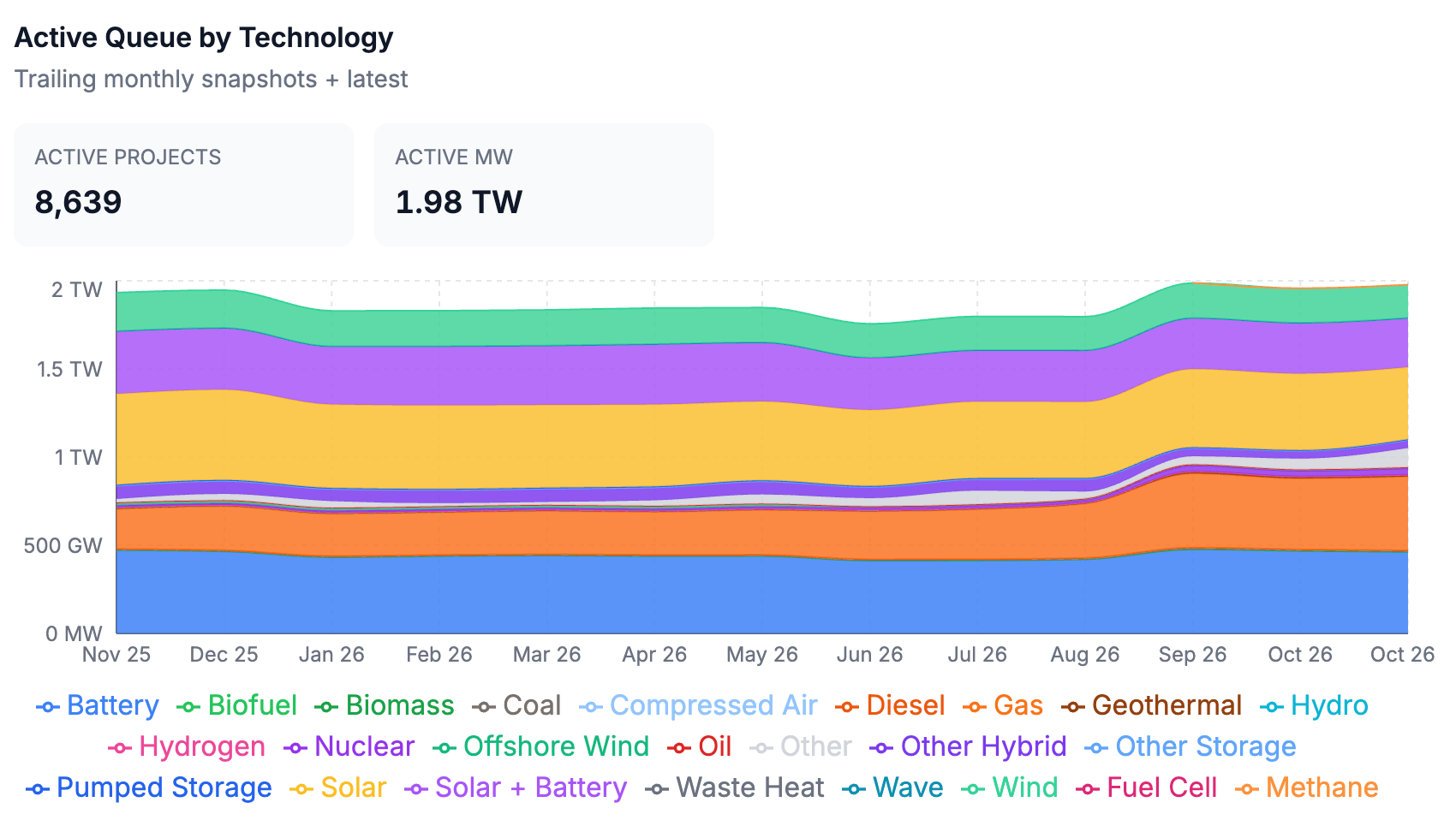
Active capacity stands at about 1.98 TW, down roughly 10 GW from our last edition. Battery storage remains the largest technology at about 462 GW, followed by solar and gas (roughly 410-420 GW each), solar+battery, and wind. Solar fell by about 20 GW, mostly from the MISO DPP-2022 withdrawals.
Regional Breakdown by ISO/RTO
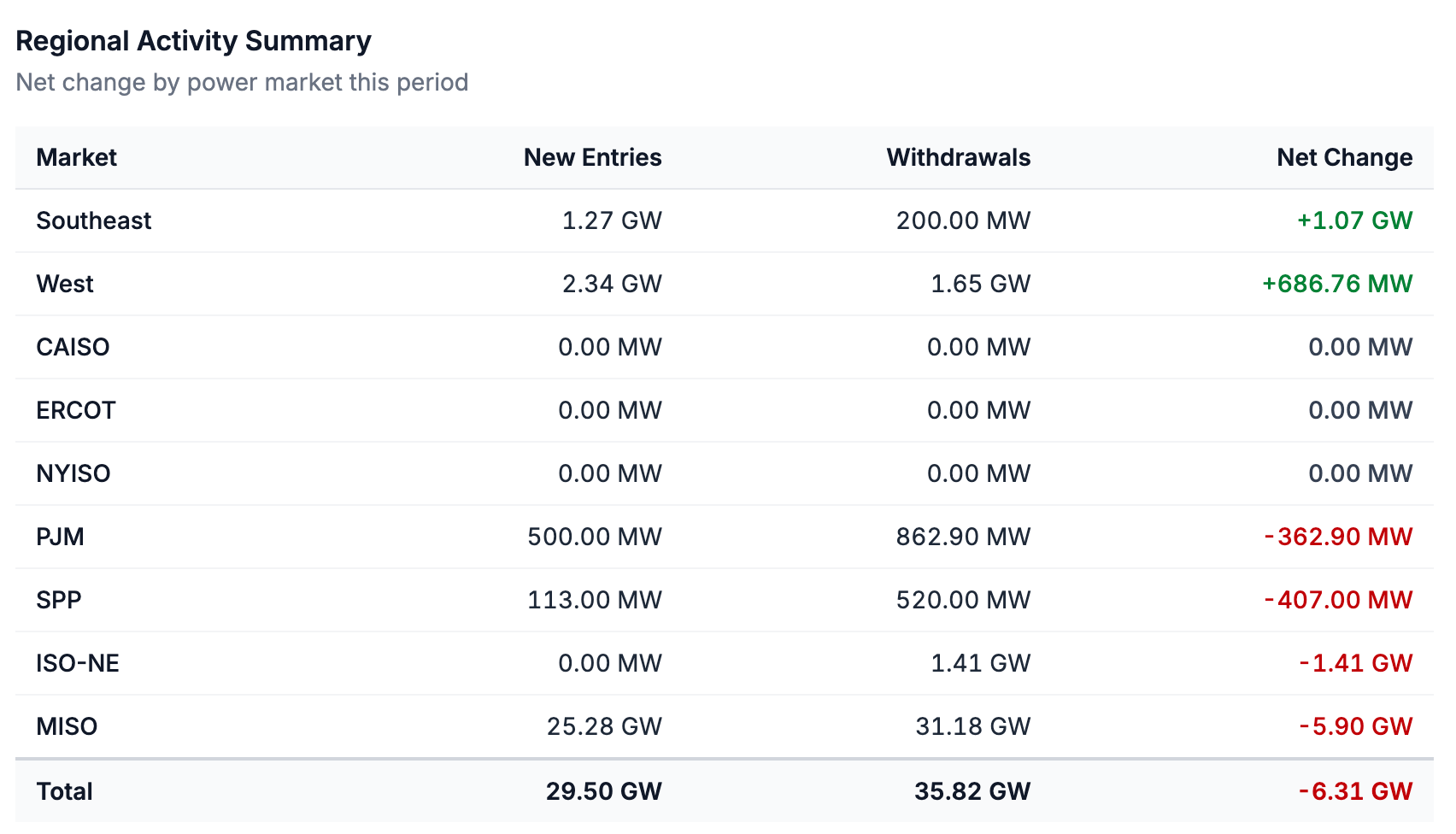
MISO posted the largest net change, with a net decline of about 6 GW. DPP-2022 withdrawals of 31 GW outweighed 25 GW of new requests. MISO’s active queue now sits at about 392 GW, behind ERCOT (446 GW) and the non-CAISO West (440 GW). ISO-NE posted the next-largest decline (1.4 GW), leaving it with about 9 GW active in its queue. The Southeast and non-CAISO West posted small net gains (about 1.1 GW and 700 MW), while PJM and SPP each declined by about 400 MW. CAISO, ERCOT, and NYISO reported no changes this period.
Notable Projects
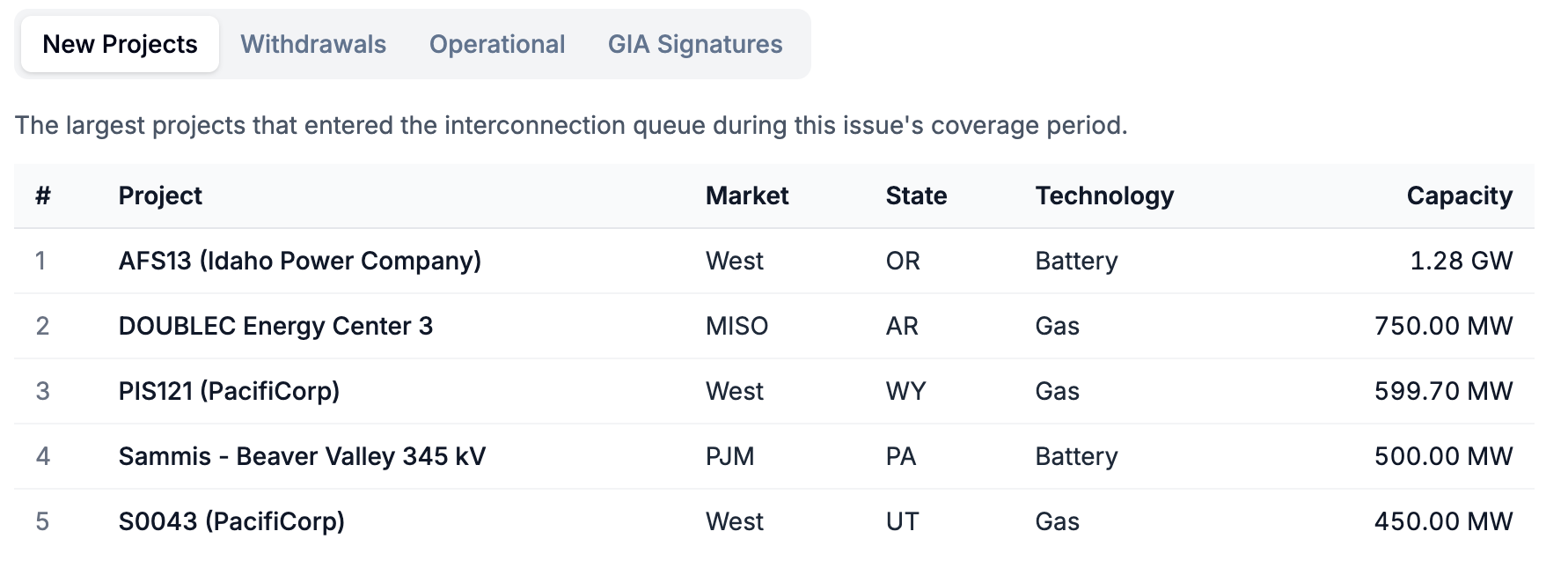
At GridTracker, we are closely following projects that are using the fast-track interconnection processes several ISOs have adopted to bring new generation online faster to meet growing demand. These include MISO’s Expedited Resource Addition Studies (ERAS), SPP’s Expedited Resource Adequacy Study (also ERAS), and PJM’s Expedited Interconnection Track (EIT). Alongside the DPP-2022 withdrawals, MISO posted six new ERAS requests this period, totaling about 1.9 GW.
The two largest new ERAS requests are Entergy Arkansas’s DOUBLE C Energy Center 3 and 4, a 750 MW combined-cycle and a 250 MW simple-cycle gas plant in Crittenden County, Arkansas. Their records say both will “serve long term resource adequacy of new large loads” in MISO’s Local Resource Zone 8. It’s worth noting that the DOUBLEC requests propose connecting to the West Memphis-Keo 500 kV line, which is the same POI where two DPP-2022 solar requests (900 MW) withdrew this period after receiving about $470 million in upgrade allocations. The other four requests, including NIPSCO’s 201 MW Project Atlas battery and a 400 MW battery in Vermillion County, Indiana, are also tied in their records to specific new large loads.
Want to go deeper? GridTracker users get access to:
Project-level insights (see the project-level changes that occur in real-time)
Exportable datasets (export the full list of newly operational, withdrawn, GIA-signed, and added projects)
Interactive graphs and visualizations
Custom dashboards with real-time alerts and data export
Exclusive in-depth industry reports
… and much more!