


Executive Summary
While generator interconnection queues stayed relatively static for the past couple of weeks, policies governing large loads moved dramatically. This edition will focus largely on the most crucial policy updates that moved across regulators’ desks.
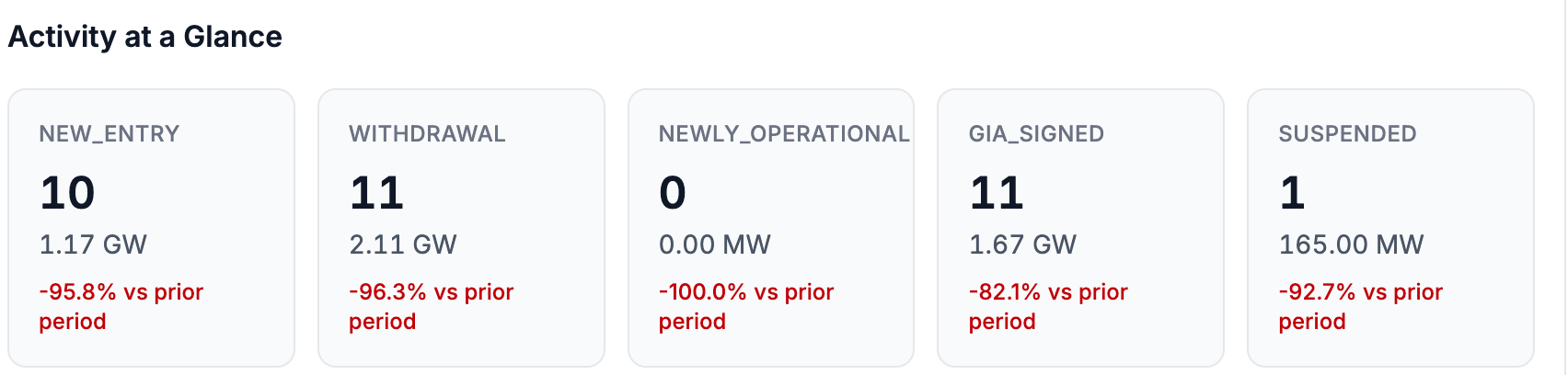
Quick queue stats:
New entries: 10 new projects, totaling 1.17 GW
Withdrawals: 11 projects, totaling 2.11 GW
GIAs signed: 11 projects, totaling 1.67 GW
Policy Watch
Regulators have been moving fast to define how large loads will be managed in their respective territories, and the strategies are highly varied between jurisdictions.
What is a large load, anyways?
Regulators’ definitions vary widely. Here are just a few examples:
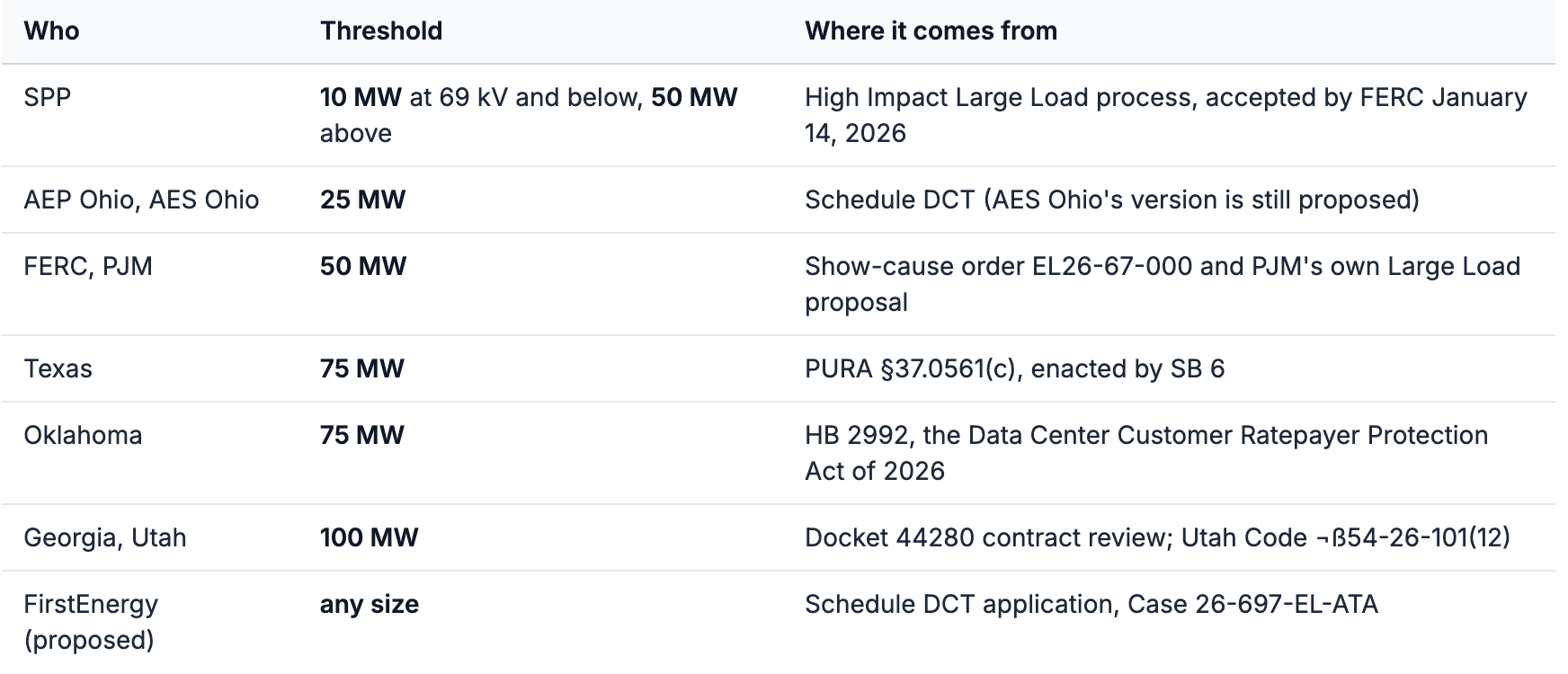
So SPP’s and Georgia’s definitions differ by a factor of ten. FirstEnergy in Ohio has asked to apply its data center tariff to any data center of any size at all.
A 40 MW facility could simultaneously be a regulated data center under AEP Ohio’s tariff, an ordinary commercial customer in Georgia, Texas and Oklahoma, and, if you interconnect at 69 kV or below anywhere in SPP, already a High Impact Large Load at the federal level.
One caution before you use these numbers to plan anything: a threshold marks the point above which a regime definitely catches you. But falling below it does not make you safe from the “large load” treatment. PJM has reserved the ability to spread backstop costs across all load in a zone when the local utility declines to assign them, so a 40 MW facility in Ohio may end up paying for capacity it was never originally classified as needing.
Texas: the load queue is frozen, but the rulebook is finally coming into focus
Governor Abbott sent a letter on August 3 directing the PUCT and ERCOT to run a “comprehensive verification and audit” of every data center in the interconnection queue before any more advance. ERCOT missed its August 7 classification deadline and the Batch Zero study slipped. It did get one critical piece out the door, though. On September 3, it told developers which projects it treats as already cleared and which still have to go through the study. Those calls are provisional and projects can still move between the two categories. The study itself is waiting on Abbott’s audit.
ERCOT can afford to be choosy, even hard-nosed. The queue holds more than 1,800 projects representing over 474 GW, roughly 90% of it data centers, against a grid whose record peak sits under 90 GW. Significant attrition is unavoidable, so from ERCOT’s perspective, it may as well happen on their terms.
The same day ERCOT was sorting projects, PUCT staff filed the recommended adoption order for new 16 TAC Sec. 25.194, the rule implementing SB 6. It’s 280 pages, and it finally puts a clear price on withdrawal.
A large load posts $50,000 per MW to get into the study. It gets 20% back at energization, and the rest in 20% increments as it hits the milestones for paying its minimum billing demand. Withdraw after ERCOT has handed you transmission capacity, though, and you forfeit: 20% if you were studied load, and 50% if you were base load that had studies and permits and stopped there.
Keep in mind that staff recommended the rule, and the signature block is still blank.
Order Adopting New 16 TAC 25.194: GridTracker subscribers can view the filing here
Ohio: the hyperscalers showed up in person
Reply comments closed August 25 in FirstEnergy’s data center tariff case, and the filers include Google and Amazon Data Services directly.
The fight is over the definition of a data center, so let’s start with what FirstEnergy proposed. The PUCO ordered the company in May to file “an application for tariff approval creating a separate class for data centers to assure that future costs are properly allocated to data centers.” FirstEnergy’s June filing defines that class by what a customer does: a centralized facility used primarily or exclusively for electronic information services. Notably, no megawatt floor appears anywhere in that definition. A 15 MW back-office data center for a bank lands in the same class as a gigawatt AI campus, and a 500 MW steel mill is excluded entirely from the same responsibilities that those data centers incur. The tariff also catches mixed sites, so a factory with enough servers on the premises can find its entire electric service billed under Schedule DCT unless it pays to meter the two loads separately.
Google wants Ohio to key the tariff to load size at the federal 50 MW line instead. That swaps the criteria: large manufacturers come in, data centers under 50 MW drop out, and the eventual PJM backstop bill gets divided across every big load in the zone rather than landing on data centers alone.
Google’s stated reasoning is cost allocation. PJM plans to hand each zone a bill for the backstop capacity it is procuring and leave the state to decide which customers pay it. If Ohio’s tariff covers a different group than PJM’s 50 MW definition does, the utility has no mechanism to charge that 500 MW steel mill for costs PJM says it caused, and the unassigned share spreads across every customer in the zone, residential included.
Ohio’s manufacturers arrive at the same definitional point from the other direction, arguing that singling out an industry is discriminatory under state law. PUCO Staff and the Consumers’ Counsel want the opposite, a tariff aimed squarely at data centers at 25 MW and above. Amazon leaned on the White House ratepayer pledge it signed and asked for cost-causal treatment with enforceable commitments.
Three days later AEP Ohio issued revised Schedule DCT sheets. Above 25 MW there, you take a four-year maximum ramp with capacity floors of 50/65/80/90 percent, an 85% billing demand floor after that, a $20,000 monthly charge at transmission voltage, and 180 days’ notice plus the full cost of a procurement if you want to return to standard service.
GridTracker subscribers can see Google’s reply comments here
Georgia: OpenAI’s 3.2 GW cleared, and the residential commitment doubled
Georgia Power has now run seven large load contracts through the review process the Commission set up in 2025. The customers are confidential, since each contract and its supporting documents are filed as trade secret in their entirety, but the sizes are public. In order of approval: 180 MW, 800 MW and 901 MW cleared in October 2025, 1,400 MW in December, 523 MW in March, and another 1,400 MW in April. Those six come to roughly 5.2 GW.
The seventh is 3,210 MW by itself.
That one is OpenAI’s, for a campus in Effingham County. Georgia Power filed it for Staff review on July 15. On August 12, Sierra Club, the Southern Alliance for Clean Energy and NRDC wrote to the Commission asking Staff to object and urging rejection unless the contract carried protections strong enough to keep existing ratepayers off the hook for what they called “this extraordinarily large new load.” It was deemed approved two weeks later, on August 26.
However, the approval came with a price. Georgia Power had already committed to filing its 2028 rate case in a way that puts at least $8.50 a month of downward pressure on a typical residential bill through 2029 to 2031. The same joint statement that cleared the OpenAI contract raised that floor to $15.00, conditional on enough contracts materializing to fill the certified capacity.
Georgia also defined the failure case. If a data center terminates early, Georgia Power will absorb the resulting revenue deficiency rather than seek it from customers below 100 MW. Whatever survives termination payments and mitigation goes to the Commission, which may assign it to other large load customers.
Seven contracts in, the residential commitment has nearly doubled. And the most recent contract is now worth nearly two thirds of the first six combined, which is a stark signal of how quickly the leverage is moving on both sides of the table.
GA Sources (Links require GridTracker access)
The story:
Joint Statement of Commission Staff and Georgia Power, August 26, 2026. Carries the seventh contract’s approval, the $8.50 to $15.00 increase, the Non-Large Load definition, and the early-termination provisions
Joint Letter on Data Center Load Growth and Ratepayer Protections, August 12, 2026. Sierra Club, SACE and NRDC name the OpenAI contract, put the load at 3.2 GW, and urge rejection
Notice of Filing, seventh large load contract, July 15, 2026. The 3.2 GW OpenAI contract filing, trade secret in its entirety
Large Load Incremental Revenue Filing, August 27, 2026. Sets the minimum revenue estimate the $15.00 floor depends on
The seven executed contracts, in order of approval:
If you don’t have GridTracker access, we still love you: all filings can be found in Georgia PSC Docket No. 44280.
Oklahoma: a judge blessed bring-your-own-generation
An Administrative Law Judge recommended on August 21 that the Corporation Commission adopt a large load tariff negotiated by Google, the Commission’s own Public Utility Division, and the Petroleum Alliance of Oklahoma. The Attorney General signed it, but later withdrew.
The tariff’s self-supply option lets a customer above 75 MW build its own generation, serve its own load, and keep Public Service Company of Oklahoma (PSO) as its retail supplier of record. That route requires no collateral, and the contract runs ten years, the shortest term allowed by statute. Taking PSO’s generation instead would require posting collateral worth 48 months of non-fuel minimum bills and signing a fifteen-year contract. The Administrative Law Judges (ALJ) found the arrangement smells like wheeling while stopping just shy of it, since PSO remains the retail supplier.
Exceptions were filed September 1, and the Commission has scheduled an en banc hearing for October 1.
One provision in HB 2992 deserves more attention than it has gotten. A large load customer that buys rural land outside a municipality has 60 days to notify the Commission, the county, and every abutting landowner by certified mail. Missing that deadline costs $1,500 per day, per violation.
Developers will probably read that penalty as a potential line item rather than a deterrent. The letters themselves cost almost money to send, but the real cost is anonymity, and anonymity during land assembly is worth far more than the fine, because the moment the neighbors know a deep-pocketed buyer is assembling next door, every nearby landowner’s price will go up. At roughly $547,500 a year, a developer putting together a multi-gigawatt campus may view the penalty as a rounding error.
Two things could change that math. First, the statute never defines a “violation.” So if each un-notified neighbor counts separately, then the annual figure multiplies. Second, it reaches only entities that purchase land, and doesn’t say anything about options and leases, which developers routinely use to tie up parcels instead of outright parcel purchases.
Utah: large loads can leave the utility’s generation service and keep its transmission
Reply comments landed September 4 in Utah’s rulemaking on its Large-Scale Electric Service Act, and the framework differs markedly from those discussed above.
Utah’s law, in effect since May 2025, lets a customer expecting to reach 100 MW within five years buy its power from someone other than the utility. The customer signs a large load contract with a large-scale generation provider, which is a non-utility that registers with the Commission, and takes service one of two ways.
Option 1: A connected generation system plugs into Rocky Mountain Power’s transmission and runs independently of the utility’s own fleet.
Option 2: A closed private generation system sits physically disconnected from the grid and feeds the customer directly.
Once that large load contract is in place, the statute says Rocky Mountain Power, “has no duty to serve a large load customer except as explicitly provided in a large load contract,” owes it no backup power beyond what the contract spells out, and can refuse to buy any power a connected system sends back. In the connected case, the load customer still uses the utility’s transmission. It just stops being the utility’s job to keep them supplied.
So the rulemaking is a negotiation over the terms of that exit. How long does the utility get to verify that a private system is genuinely isolated from the grid? Rocky Mountain Power wants seven business days, counted from the moment it holds complete documentation rather than from the customer’s first request.
Who pays for the transmission that already exists? Rocky Mountain Power proposed a peak demand charge pulled from its FERC-approved rates, which sidesteps running a fresh cost study inside the Act’s 60-day window for filing a contract. A third question is whether any of this reaches the distribution system, and Rocky Mountain Power says the statute grants no open access there, only service under an agreement with the company.
Everywhere else on this list, regulators are writing rules for getting large loads connected and served: what they post up front, and what they commit to over time. Utah’s law heads the other way. It lets a registered non-utility take over supplying the customer, leaving Rocky Mountain Power as the transmission provider with no obligation beyond whatever that individual large load contract spells out. The money question in it is how much of Rocky Mountain Power’s embedded transmission revenue requirement a customer still owes after it leaves the utility’s generation service, and how much shifts to the customers who stay.
Rocky Mountain Power’s reply comments
Why all of this is happening at once
Every jurisdiction here is grappling with the same load growth, and their solutions differ because each market is unique.
FERC ordered all six RTOs and ISOs on June 18 to justify or reform how their tariffs handle large loads. That reaches two states on this list. Ohio sits in PJM and Oklahoma sits in SPP, so both will eventually have a federal wholesale definition to reconcile against. ERCOT sits outside FERC’s jurisdiction over transmission rates and wholesale sales, so the FERC orders don’t apply there. Texas had already established its own framework in SB 6. Georgia and Rocky Mountain Power’s territory in Utah have no RTO and no federal large-load docket at all, so a state contract review process and a state statute will need to define their entire framework.
Of all the states discussed in this post, the one with the nearest deadline is Ohio. PJM’s capacity auction for 2028-2029 came up short, and PJM is running a one-time backstop procurement to fill the gap, with commitments running as long as 15 years. The offer window is targeted to open September 30, pending FERC’s acceptance of the filing.
When it clears, PJM assigns the cost to each utility zone and leaves the states to decide how it gets distributed to retail customers. That is the question Ohio has been arguing about all summer, and every state in the PJM footprint will need to grapple with their portion of the costs.
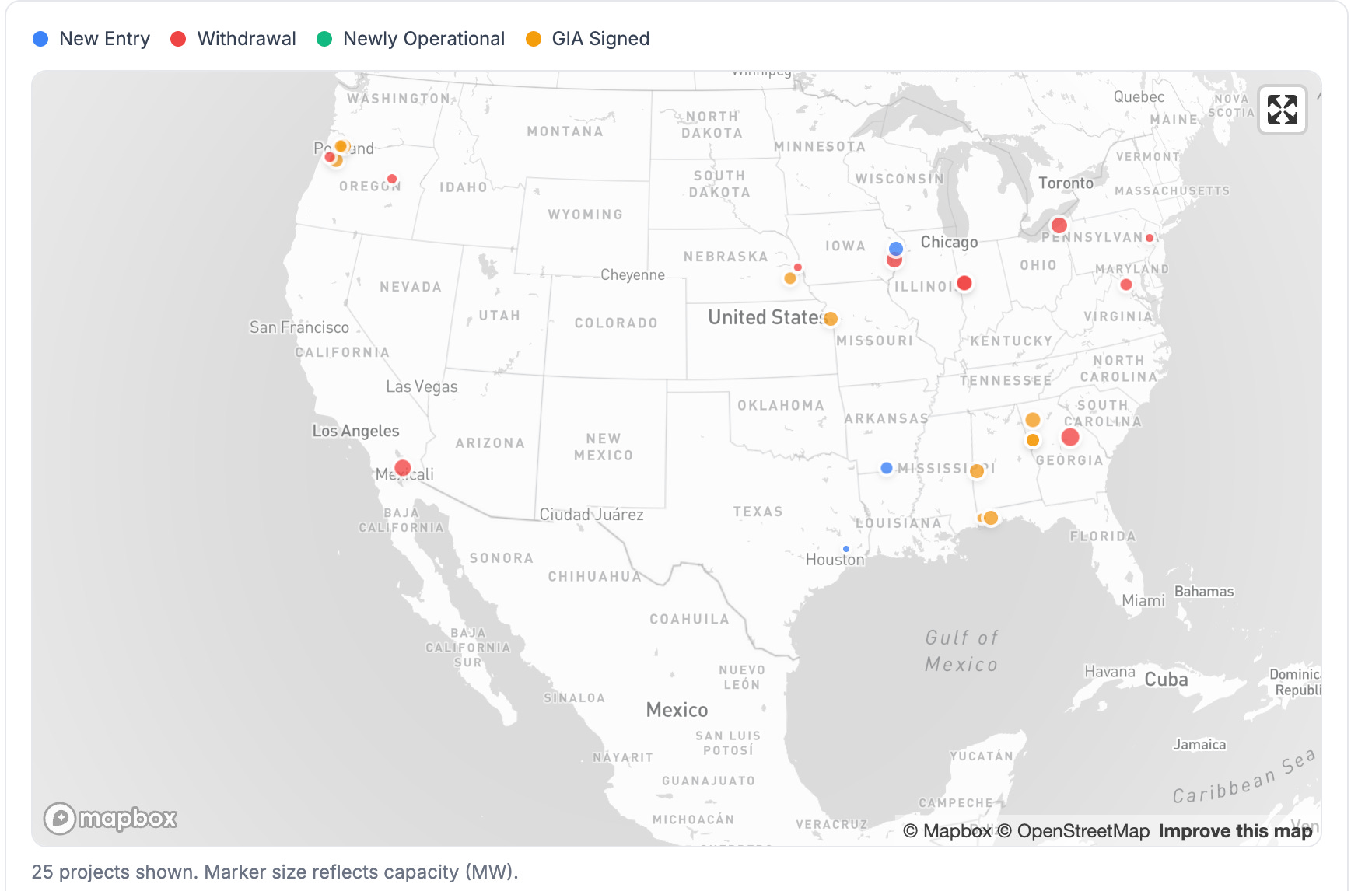
Activity Map
Queue Activity
Want to go deeper? GridTracker users get access to:
Project-level insights (see the project-level changes that occur in real-time)
Exportable datasets (export the full list of newly operational, withdrawn, GIA-signed, and added projects)
Interactive graphs and visualizations
Custom dashboards with real-time alerts and data export
Exclusive in-depth industry reports
… and much more!